What’s included in a Nile cruise?
Cabin, all meals, guided temple tours, an Egyptologist, transfers, entertainment & port fees are included in nearly every package.
- 🛏️ Private en-suite cabin + all meals (breakfast, lunch, dinner) daily
- 🏛️ Guided excursions to major temples with a licensed Egyptologist
- 🚐 Ship-to-site transfers , onboard entertainment & port fees included
- 🚫 Not included: flights, visa ($25), alcohol, tips, Abu Simbel, insurance
- 💰 Tip guide: $10–$15/day crew, $10–$20/day Egyptologist guide
If you are planning a trip to Egypt and considering a Nile cruise, the first question you almost certainly have is a practical one: What exactly do I get for my money? It is a fair question, and one that deserves a direct, honest answer — not a vague list of marketing phrases.
I have spent years helping travelers plan their Nile cruise journeys, from first-time visitors choosing a standard ship to honeymooners booking private dahabiya sailings. During that time, I have learned that the travelers who enjoy their cruise most are those who arrive knowing exactly what is included, what is not, and what to expect at every stage of the journey.
This guide covers all of it — in plain language, with real numbers and genuine recommendations.
What Is a Nile Cruise, and How Does It Work?
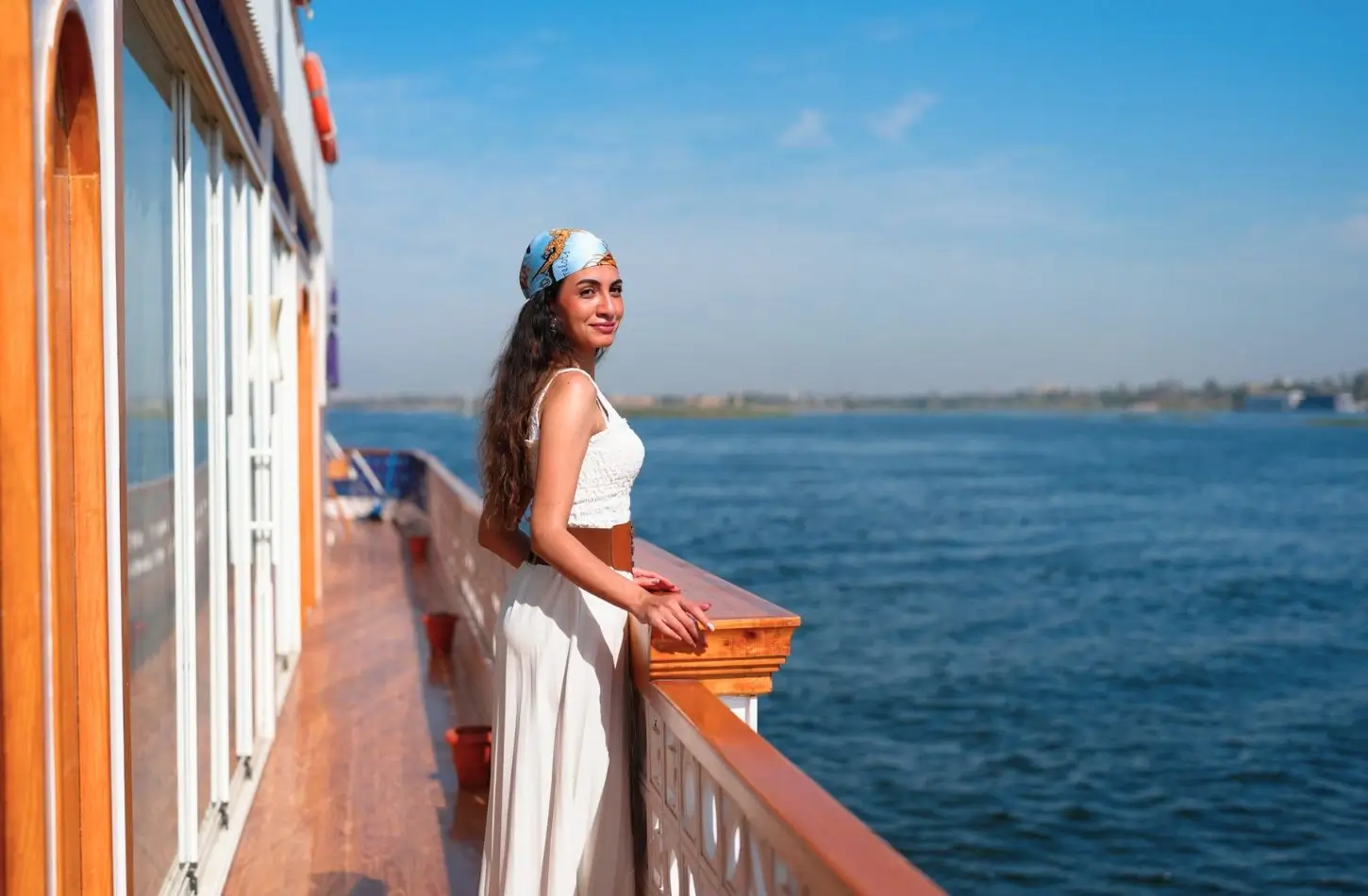
A Nile cruise is, quite simply, like a floating hotel. You board in either Luxor or Aswan, unload your luggage once, and the ship takes you between two of ancient Egypt’s greatest cities, stopping at temples, tombs, and archaeological sites along the way. You sleep, eat, and relax on board. Your excursions take place on shore, accompanied by an Egyptologist who guides you throughout the journey.
The beauty of this model lies in its simplicity. Instead of moving between multiple hotels, navigating unfamiliar roads between cities, or rushing to do everything in a single day trip, the river does all the work for you. You wake up each morning in a new location, spend your day exploring at a leisurely pace, and return to the same comfortable ship each evening.
The most popular route is between Luxor and Aswan, two cities separated by approximately 140 miles of the Nile, whose banks are lined with some of the most magnificent monuments ever built. This is the route I recommend for most first-time travelers to Egypt.
How Long Is a Nile Cruise?
Nile cruises run on three standard durations, each covering the same core route at a different pace.
- 3 to 4 nights is the shortest option, typically departing from Aswan and ending in Luxor. It covers the essential sites — Philae Temple, Kom Ombo, Edfu, and the Valley of the Kings — at a brisk but manageable pace. This works well for travelers who want the Nile experience but have limited time in Egypt.
- 5 to 7 nights is the most popular duration, and the one I most often recommend for a first visit. It allows a relaxed pace at each temple, time to enjoy the ship itself between stops, and a more complete picture of Upper Egypt. Most Egypt Nile cruise packages are built around this format.
- 8 to 14 nights is available on select luxury ships and dahabiya sailings, often beginning in Cairo and incorporating Abu Simbel or a Lake Nasser extension. This extended format suits travelers who want the deepest possible immersion in Egyptian history and culture.
Departure days follow a fixed schedule — most commonly Monday, Thursday, and Saturday from Luxor, and Saturday, Monday, and Thursday from Aswan. I always recommend booking your cruise before arranging flights around it, not the other way around.
What Is Always Included in a Nile Cruise Package
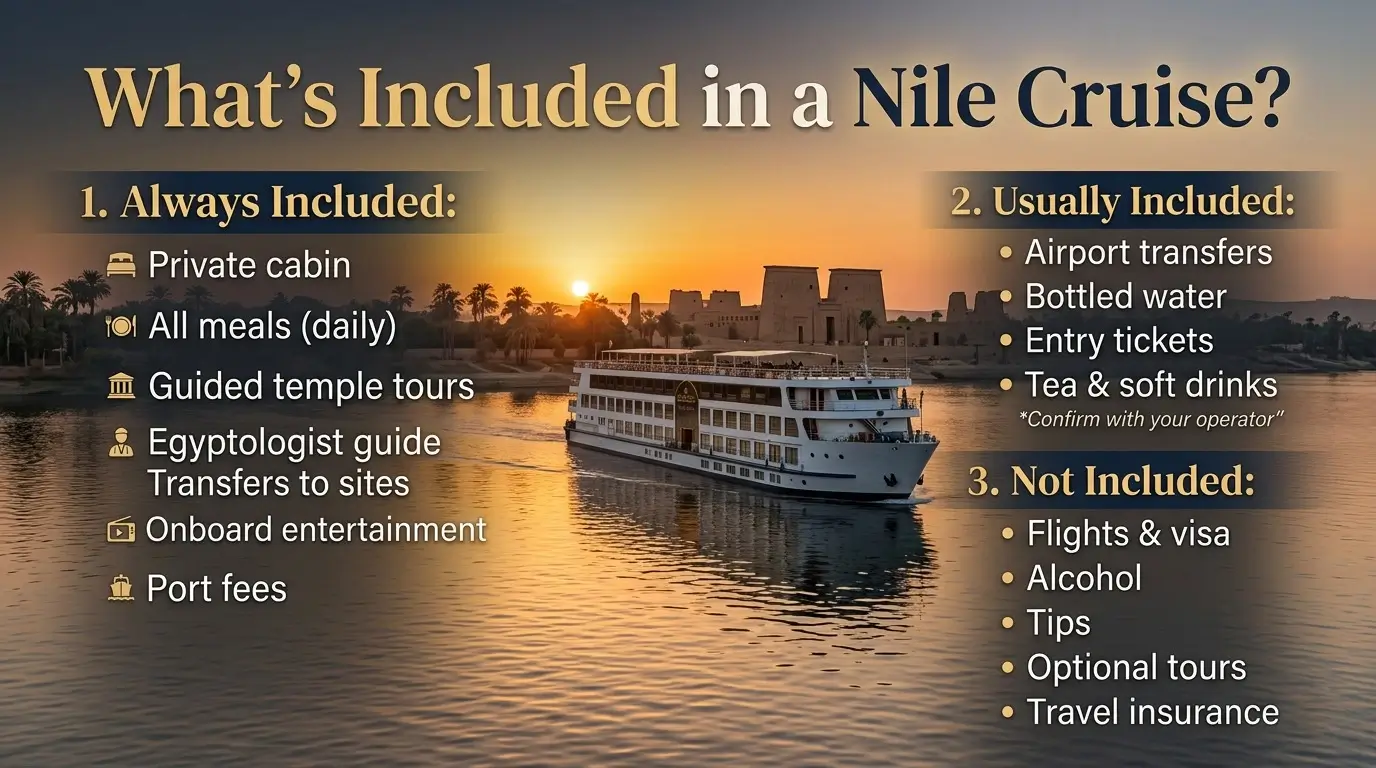
This is the question at the heart of this guide, so let me answer it directly. Regardless of which cruise category you choose — standard, deluxe, or luxury — the following are included in virtually every Egypt Nile cruise package:
Always included:
- Private en-suite cabin accommodation for the full cruise duration
- All meals on board — breakfast, lunch, and dinner, every day
- Guided excursions to all major temples and historical sites on the itinerary
- A licensed, professional Egyptologist guide for the entire journey
- Transfers between the ship and each temple site
- Onboard entertainment (cultural evenings, music performances)
- All port fees and docking charges
Usually included — confirm with your operator:
- Airport or hotel transfers at the start and end of the cruise
- Bottled water during excursions
- Entry tickets to archaeological sites (some operators charge these separately)
- Tea, coffee, and soft drinks throughout the day on board
Not included in most standard packages (more on this below):
- International flights
- Egypt visa fee
- Alcoholic beverages
- Tips for guides and crew
- Optional excursions (hot air balloon, Abu Simbel, sound and light shows)
- Personal travel insurance
Understanding this distinction upfront prevents the most common source of disappointment I hear from travelers — discovering additional costs mid-cruise that were never discussed at the time of booking. Always ask your operator for a written list of inclusions before paying a deposit.
Accommodations: What Your Cabin Actually Looks Like
One of the things that surprises first-time Nile cruisers most is the quality of the cabins. These are not compact ship berths — they are proper hotel rooms that happen to float.
On a standard 5-star Nile cruise, cabins are typically 18 to 22 square meters with large panoramic windows or a private balcony overlooking the river. Every cabin includes a private bathroom with a shower, air conditioning, a wardrobe, a writing desk, satellite television, a telephone, and daily housekeeping. Beds are made up with proper hotel-quality linen, changed throughout your stay.
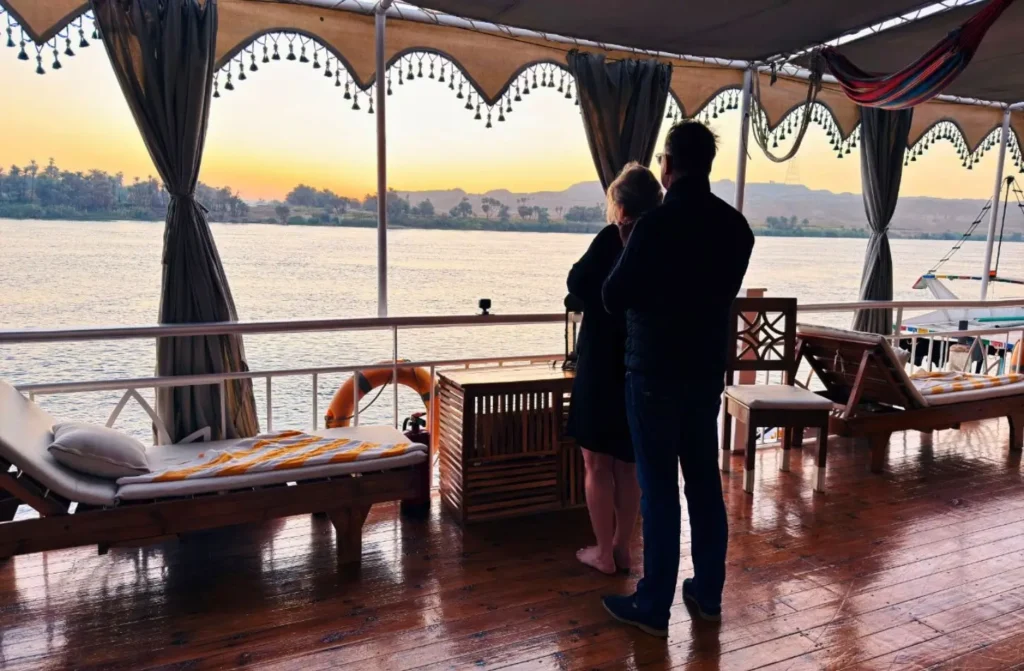
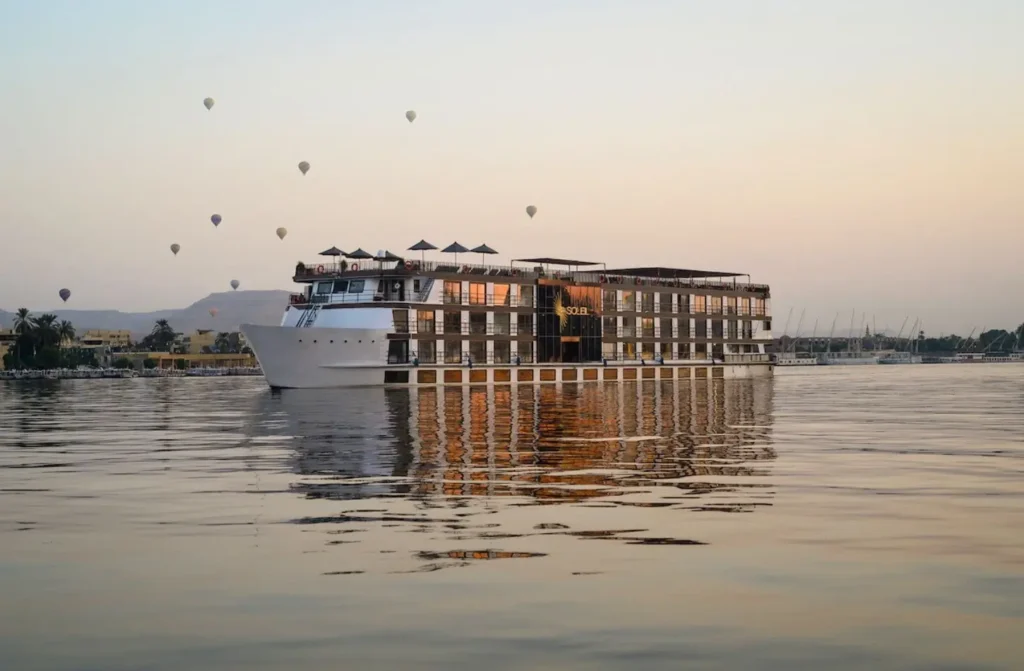
The ships themselves are designed with multiple decks — a main deck for cabins, an upper deck for the dining room and lounge, and a sun deck on top with a swimming pool, sun loungers, and an open bar area. The architecture prioritizes river views from every public space.
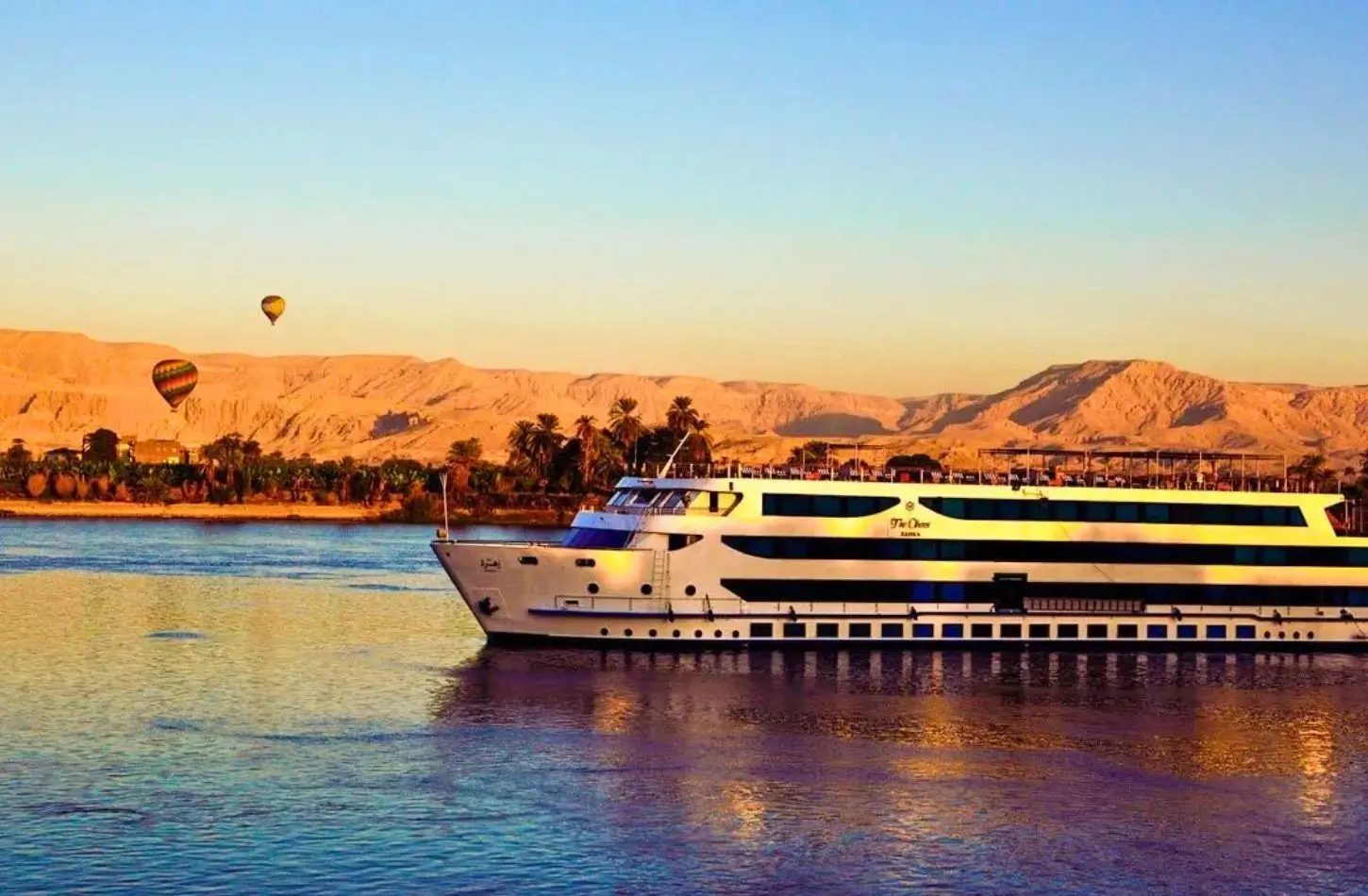
On luxury Nile cruises, suites offer significantly more space — sometimes 40 to 60 square meters — with separate living areas, premium furnishings, and in some cases a private wraparound terrace. Ships at this level, such as the Oberoi Zahra or the Sanctuary Sun Boat, are genuinely comparable to a boutique five-star hotel in their design and finish.
Interior design on most ships reflects Egyptian culture — warm earth tones, decorative motifs inspired by hieroglyphics and temple carvings, and artwork that connects the space to the surrounding landscape. It is not theatrical or kitschy; on the better ships, it is genuinely elegant.
Dining on Board: Meals, Menus, and What to Expect
Food on a Nile cruise is one of the great underrated pleasures of the journey, and I say that as someone who is genuinely particular about eating well.
On standard and deluxe Nile cruises, meals are served buffet-style in a spacious dining room with river views. The spread is generous and varied — Egyptian and international dishes running side by side at every meal. Breakfast typically features ful medames (Egypt’s classic slow-cooked fava bean dish), fresh bread, local white cheese, eggs prepared to order, fresh fruit, yogurt, and a full selection of Western breakfast items. Lunch and dinner rotate through grilled meats, fresh fish, rice dishes, mezze spreads, roasted vegetables, and freshly made soups, with dessert served at both.
The quality of the ingredients is consistently good — produce is sourced locally and prepared fresh daily by an onboard kitchen team. In my experience, travelers who arrive expecting airline-quality food leave pleasantly surprised.
On luxury ships and dahabiya sailings, dining shifts from buffet to à la carte or table d’hôte service — a considerably more intimate experience. Meals are plated individually, menus are curated, and dining often takes place on an open deck under the stars. This is where Nile cruise dining moves from good to genuinely memorable.
One important clarification I always make to travelers: alcoholic beverages are not included in most standard packages. Beer, wine, and spirits are available on board but charged separately at bar prices. Tea, coffee, soft drinks, and water are included throughout the day.
For a deeper look at Egyptian food culture on the Nile, I have written a detailed guide to Egyptian cuisine on a Nile cruise that covers specific dishes, dietary accommodations, and what to request from your chef.
Guided Excursions: Temples and Sites You Will Visit
Each excursion includes guided visits to Egypt’s most magnificent monuments, accompanied by a licensed Egyptologist. A standard cruise from Luxor to Aswan includes:
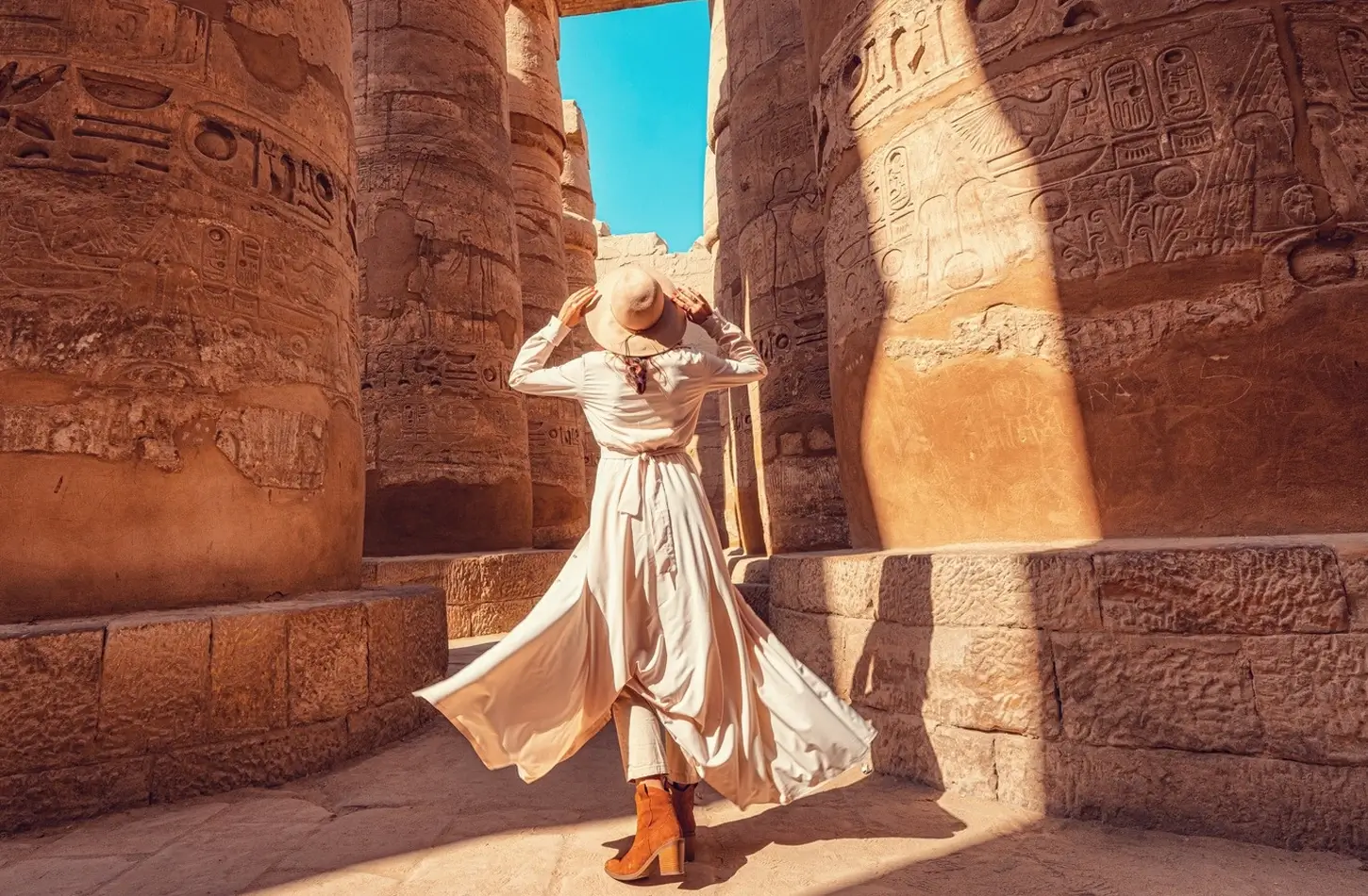
- Karnak Temple – The largest religious complex ever built, famous for its stunning Great Hypostyle Hall
- Luxor Temple – Exquisitely preserved and dazzling when illuminated at night
- Valley of the Kings – Over 60 royal tombs with vibrantly painted walls; the excursion typically includes entry to three temples:
- Temple of Hatshepsut: Three-columned terraces carved into the cliff face at Deir el-Bahari
- Temple of Edfu: One of the best-preserved Egyptian temples, accessible by horse-drawn carriage from the dock
- Temple of Kom Ombo: A unique double temple located directly on the banks of the Nile, which also houses a crocodile museum.
- Philae Temple: Dedicated to the goddess Isis, it’s located on an island near Aswan and is accessible by motorboat.
Standard tours do not include a visit to Abu Simbel, so please arrange a separate day trip from Aswan with your tour operator before departure.
Don’t miss the Esna Canal, where local vendors ply their way alongside the ship in small boats, selling scarves and papyrus. It’s a lively and joyful experience, and one of the most memorable moments of your entire cruise.
Onboard Entertainment and Cultural Experiences
Evenings on a Nile cruise are truly enjoyable, and the cultural programs often exceed most travelers’ expectations. Most ships offer a regular program of evening events, including:
The Galabeya Party, a beloved tradition on most Nile cruises, invites guests to wear the traditional Egyptian galabeya (a long, flowing robe), which is available for borrowing or purchase on board. The crew wears festive attire, Egyptian music fills the hall, and the evening takes on a celebratory and interactive atmosphere that breaks down the usual barriers between passengers.
The Tanoura Show is a performance of the ancient Sufi whirling art, in which dancers in multi-layered, brightly colored skirts spin in continuous, meditative motion for extended periods. This show is one of the most dazzling Egyptian folk performances, captivating everyone and interrupting conversations mid-sentence.
Many cruises include a Nubian musical evening, often featuring musicians from the Nubian communities of Aswan, who present their distinctive musical heritage, which differs in rhythm, instruments, and feel from the music of northern Egypt.
Your Egyptologist guide will usually give informal evening lectures about the sites for the following day, which I always encourage guests to attend; arriving at a temple with prior knowledge of its history is a completely different experience than arriving without any.
Ship Facilities and Onboard Amenities
Modern Nile cruise ships are well-equipped floating hotels. On 5-star standard ships, standard facilities include a rooftop swimming pool (heated on some ships), sun deck with loungers, an air-conditioned lounge and bar, a dining room, a small gift shop, laundry service, 24-hour reception, and Wi-Fi in public areas (usually charged separately or at limited speeds — do not plan to stream video).
On deluxe and luxury ships, facilities expand to include a full spa and wellness center offering massages and beauty treatments, a fitness room, multiple dining venues, a library, and premium Wi-Fi. Some ships — including several in the luxury category — have private balconies on all cabins, which significantly changes the experience. Waking up and opening your balcony door to the Nile at sunrise is not something you forget quickly.
Medical assistance is available on most ships, and dietary requirements — vegetarian, vegan, gluten-free, halal — can almost always be accommodated if communicated to your operator before departure.
What Is NOT Included — and What Surprises Travelers Most
This is a section I wish every traveler read before booking. The most common source of frustration on a Nile cruise is not poor service or disappointing temples — it is unexpected costs that nobody mentioned at the point of sale.
Tipping is the biggest one. In Egypt, tipping is not optional — it is a meaningful part of local income and a genuine cultural expectation. I recommend budgeting $10 to $15 USD per person per day for the ship’s crew (distributed collectively at the end of the cruise through the head of service), and $10 to $20 USD per day for your Egyptologist guide. This adds up across a week but represents a significant portion of local livelihoods, and I have never met a traveler who regretted tipping generously.
Optional excursions are frequently the second surprise. Hot air balloon rides over Luxor (one of the world’s great sunrise experiences, typically $80 to $150 per person), the Philae Temple Sound and Light Show, the Abu Simbel day trip, and certain premium temple entry fees are almost never included in the base package. Ask your operator for a specific list of which excursion costs are included and which are charged additionally before you sign anything.
Alcoholic beverages are charged at bar prices on virtually all standard and deluxe ships. Budget accordingly.
The Egypt tourist visa currently costs $25 USD and is paid on arrival at the airport. It is not covered by any cruise package.
Personal travel insurance is never included and always essential. Egypt is a safe country for tourism, but I always recommend comprehensive travel insurance that covers medical evacuation, given the distance from major medical centers in Upper Egypt.

Practical Tips Before You Board
A few things I tell every traveler before they set foot on a Nile cruise ship:
- Dress for temples. Every major Egyptian temple requires covered shoulders and knees. Light linen shirts and loose trousers are ideal — they double as sun protection and are far more comfortable in the heat than they look. Pack at least three temple-appropriate outfits for a week-long cruise.
- Sun protection is non-negotiable. The Egyptian sun is intense year-round, and it reflects off the Nile, doubling its effect. Bring SPF 50+ sunscreen, a wide-brimmed hat, and UV-protective sunglasses from home — quality options are harder to find once you arrive.
- Binoculars are prohibited. Egypt’s airport security confiscates them — don’t pack them. You won’t need them; the temples are experienced at close range.
- Book optional excursions before you travel. Hot air balloon rides, the Abu Simbel day trip, and Sound and Light Show tickets fill quickly during peak season. Arrange everything with your operator before departure.
For a full packing list, see my guide to what to pack for a Nile cruise. And if you are still deciding when to go, my best time for a Nile cruise guide covers every month, honestly, including the shoulder seasons most travelers overlook.
Ready to Book Your Nile Cruise?
A Nile cruise is not just a vacation. It is one of those rare travel experiences that changes how you understand human history — and does it in genuine comfort, without sacrifice. The logistics are handled, the expert knowledge is built in, and the Nile carries you at exactly the right pace.
Browse our full range of Egypt Nile cruise packages to find the right ship, duration, and category for your travel style and budget. If you would prefer to talk it through first, reach me directly on WhatsApp at +20 115 296 5919 — I am happy to help you compare options with no obligation.
FAQ: What Is Included in a Nile Cruise?
What is typically included in a Nile cruise package?
A standard Nile cruise package includes cabin accommodation, all meals (breakfast, lunch, and dinner), guided excursions to major temples with a licensed Egyptologist, transfers between the ship and each site, onboard entertainment, and all port fees. Airport transfers and site entry tickets may or may not be included, depending on the operator — always confirm in writing before booking.
Are meals included on a Nile cruise?
Yes. All three daily meals are included in virtually every Nile cruise package. Breakfast, lunch, and dinner are served on board. Alcoholic beverages are not included and are charged separately at bar prices. Tea, coffee, soft drinks, and water are included throughout the day.
Is tipping included in a Nile cruise?
No. Tipping is not included in any cruise package but is an important cultural expectation in Egypt. I recommend budgeting $10–$15 USD per person per day for the ship’s crew, and $10–$20 per day for your Egyptologist guide.
Is Abu Simbel included in a Nile cruise?
Not in standard Luxor–Aswan cruise packages. Abu Simbel requires either a separate day trip by plane from Aswan or a Lake Nasser cruise extension, both of which are arranged and priced additionally.
How long is a typical Nile cruise?
Most Nile cruises run 3–4 nights, 5–7 nights, or 8–14 nights. The most popular and recommended duration for first-time visitors is 5–7 nights, traveling between Luxor and Aswan.
When is the best time to take a Nile cruise?
The peak season runs from October through April, when temperatures across Upper Egypt are comfortable for sightseeing. October, November, and March are particularly pleasant. December through February is the busiest period — book 4 to 6 months in advance for the best availability.
What is the difference between a standard and a luxury Nile cruise?
The temples, the Nile, and the Egyptologist guide are the same — what changes is everything surrounding those experiences. A standard 5-star cruise offers comfortable cabins, buffet meals, and a social atmosphere with 60–100 passengers — excellent value for budget-conscious or solo travelers. A luxury cruise brings larger cabins, à la carte dining, smaller excursion groups, and a less rushed pace with 40–80 passengers on board. Browse our best Nile cruise offers to compare options for your travel dates.
What is the difference between a Nile cruise and a dahabiya?
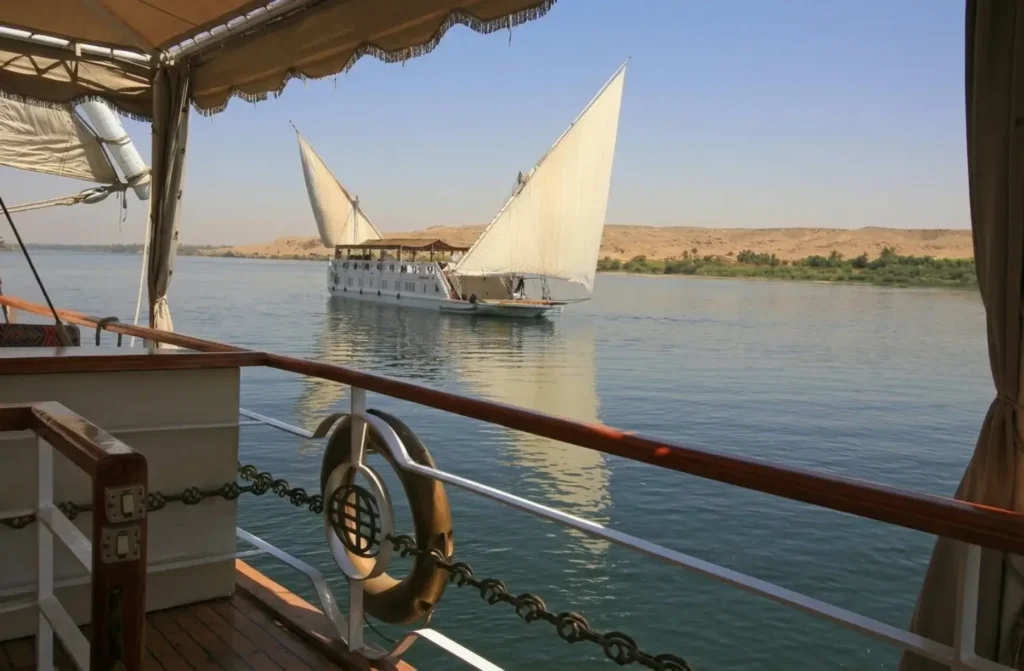
A dahabiya is a traditional wind-powered sailing boat with 4–8 private cabins — think privately chartered yacht rather than floating hotel. The difference lies in pace, privacy, and access rather than in the level of luxury. The small size allows docking at sites large ships cannot reach, and the intimate guest count means your guide tailors every excursion to your group. I recommend it for honeymooners, small groups, and travelers who prioritize cultural immersion over onboard facilities.