What is the Valley of the Kings?
A royal necropolis on Luxor’s West Bank with 60+ pharaoh tombs, built ~1550–1070 BCE, including Tutankhamun’s.
- ⚱️ Over 60 tombs (marked “KV”) for pharaohs, queens & nobles, 18th–20th dynasties
- 👑 Tutankhamun’s tomb (KV62) , found by Howard Carter in 1922, is the most famous
- 🏛️ Ramses II (KV7) & Seti I (KV17) also rest here, among Egypt’s grandest tombs
- 📍 West Bank, Luxor — often paired with Hatshepsut Temple & Colossi of Memnon
- 🔦 Used for 500+ years; new chambers still being discovered via ground radar
The Valley of the Kings sits on the west bank of the Nile in Luxor and is the royal burial ground for more than 60 New Kingdom pharaohs, including Tutankhamun and Seti I. A standard ticket costs 750 EGP (about $14 USD) and lets you visit three tombs. The site opens every day at 6:00 AM, and it’s best to arrive early.
Most weeks, I help guests plan their trips around Luxor, and almost everyone wants to see the Valley of the Kings. Still, many people don’t realize that the standard ticket includes only three tombs, or that Tutankhamun’s tomb, while famous, isn’t the most impressive to look at. I wrote this guide to share the history that makes the valley special and the practical tips that help your visit go smoothly—just what I wish every guest knew before buying their ticket.
Where Is the Valley of the Kings?
The Valley of the Kings is on the west bank of the Nile, right across from the modern city of Luxor, which was once ancient Thebes. To get there from a hotel on the East Bank, you need to cross the Nile, either by taking the Luxor Bridge to the south or by using a local ferry. After crossing, it’s a short drive inland into the Theban hills. The valley is a narrow, sun-bleached wadi surrounded by limestone cliffs, with the pyramid-shaped peak of al-Qurn rising above it. This natural landmark was linked by the ancient Egyptians to the goddess Meretseger and, according to some Egyptologists, to the idea of the primeval creation mound.
The Valley of the Kings is part of the larger Theban Necropolis, which also includes the Valley of the Queens, the Temple of Hatshepsut, and the workers’ village of Deir el-Medina. Most visitors to the West Bank see the Valley along with two or three of these other sites rather than visiting it on its own.
Valley of the Kings Tickets & Prices in 2026
This is where many first-time visitors get confused: your entry ticket does not include every tomb. It lets you into the site and gives you access to three tombs of your choice from a rotating list of about ten open ‘standard’ tombs. Some of the most famous tombs, such as those of Tutankhamun, Seti I, and Ramesses III, are not included in the standard ticket and require an additional payment.
| Ticket | Price (foreign adult) | Approx. USD |
|---|---|---|
| Standard entry (3 tombs) | 750 EGP | ~$14 |
| Standard entry, student rate | 375 EGP | ~$7 |
| Tutankhamun (KV62) add-on | 700 EGP | ~$13 |
| Seti I (KV17) add-on | 2,000 EGP | ~$37 |
| Ramesses V & VI (KV9) add-on | 220 EGP | ~$4 |
| Tomb of Ay add-on | 200 EGP | ~$3.75 |
| Tram, round trip | 20 EGP | ~$0.40 |
Egyptian nationals get a special local discount. Children under 6 can enter for free. If you have an international student ID (ISIC), you can also get a reduced rate, but you must show the actual card. A photo of the card is not accepted, and attendants will usually charge you the full price.
Which Tombs Should You Choose?
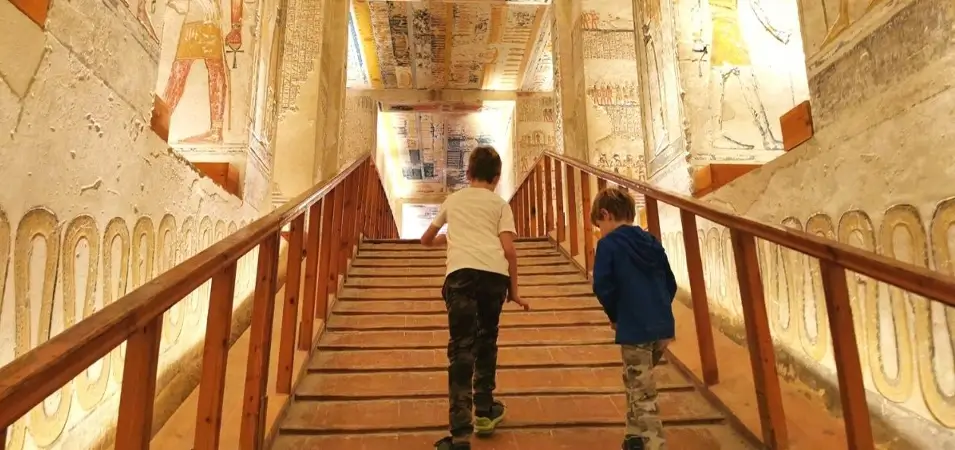
Since the standard ticket lets you choose just three tombs, your picks are more important than you might think.
For the standard ticket, I usually recommend Ramesses IX and Merenptah. Both tombs are well-preserved, rarely crowded, and showcase the classic corridor-and-burial-chamber design at no extra cost.
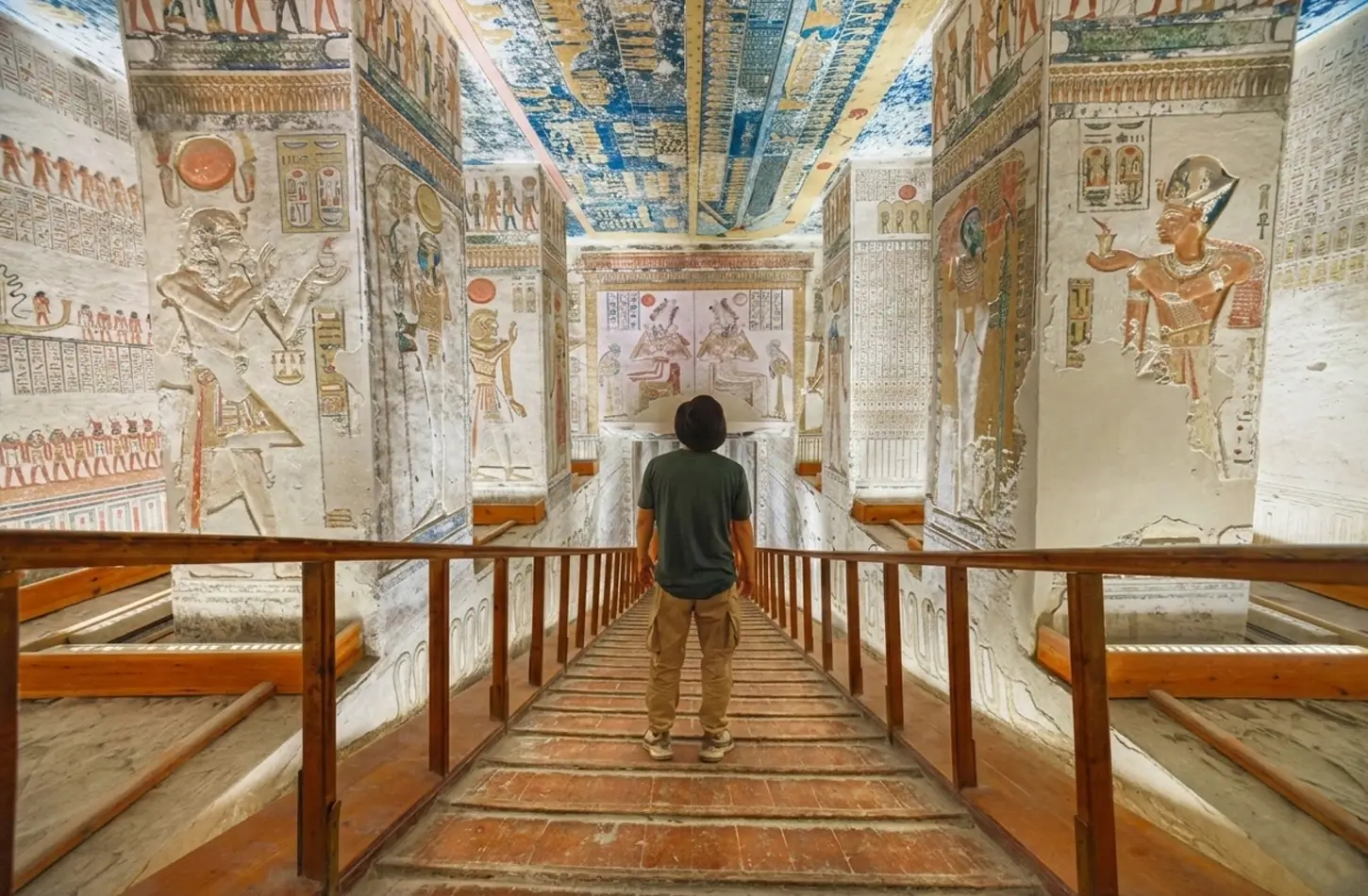
If you want to pay for one premium tomb, choose Ramesses V & VI (KV9). It has the lowest extra fee of the three, but its ceiling is among the most impressive in the valley, depicting the sky goddess Nut swallowing and rebirthing the sun. If you are really interested in art and history, you might want to pick Seti I (KV17) instead. Many people consider it the best tomb in the valley, although it is the most expensive add-on.
Pro tip from Yousef: You don’t have to add Tutankhamun’s tomb. It’s the most important historically because Howard Carter found it almost untouched, but it is not very impressive to look at. The burial chamber is small, and most of the treasures are now in museums in Cairo. Visit this tomb for its history, not for its art.
When and Why the Valley of the Kings Was Built
Construction started around 1550 BCE under Pharaoh Thutmose I of the 18th Dynasty, and the valley was used for about 500 years during the 18th, 19th, and 20th Dynasties. The move away from building pyramids was a practical choice. By this time, every pyramid in Egypt had already been robbed, so the New Kingdom pharaohs decided that a hidden, guarded valley would better protect their tombs than a monument visible from afar.
Skilled artisans from the nearby village of Deir el-Medina built the tombs. They carved sloping corridors deep into the limestone and decorated the walls with scenes from the Book of the Dead, the Book of Gates, and the Amduat. These religious texts were meant to guide the pharaoh’s soul through the underworld toward rebirth.
The Theban Mapping Project, an archive managed by Egyptologist Kent Weeks and the American University in Cairo, notes that the numbering system for these tombs, using the “KV” prefix, was first created by explorer John Gardner Wilkinson in 1827. He based the numbers on the tombs’ positions from the valley entrance heading south.rd.
Who Was Buried in the Valley of the Kings?
There are over 60 tombs in the Valley of the Kings. These tombs hold pharaohs, queens, princes, and important officials. Some of the most popular ones are:
- Tutankhamun (KV62), often called the “boy king,” was found by Howard Carter in 1922. His tomb is the only one in the Valley that was never fully looted by ancient robbers.
- Seti I (KV17) has the longest and most richly decorated tomb in the valley. The burial chamber has a ceiling painted with a star map.
- Ramesses V and VI (KV9) share a tomb that was later reused and made bigger. It is well known for its large size and a ceiling decorated with the goddess Nut.
- Merenptah (KV8) and Ramesses IX (KV6) are both included with a standard ticket. These tombs are known for being well preserved.
- KV5 is believed to be the tomb of the sons of Ramesses II. With over 100 chambers, it is one of the largest in the valley, but it is not open to the public.
Queens, princesses, and other members of the royal family were usually buried nearby in the Valley of the Queens. This area includes the tomb of Nefertari, which many consider one of the most beautifully decorated tombs in Egypt.
When Was the Valley of the Kings Discovered?
The valley was never really “lost” because people living in Qurna knew about many tomb entrances for centuries. Systematic scientific exploration started in the 18th and 19th centuries, led by European expeditions and early Egyptologists such as Giovanni Belzoni. The most important discovery happened on November 4, 1922, when Howard Carter, working for Lord Carnarvon, found the sealed entrance to Tutankhamun’s tomb. The nearly complete treasures inside, such as the gold funerary mask, nested coffins, and chariots, sparked worldwide interest in ancient Egypt and continue to influence tourism in Luxor today.
Excavation is still ongoing. Teams like the Theban Mapping Project use ground-penetrating radar and modern surveys to improve our understanding of the valley’s layout. New chambers, such as KV63, found in 2005, and KV64, found in 2011, suggest there may be even more discoveries ahead.
Best Time to Visit & Opening Hours
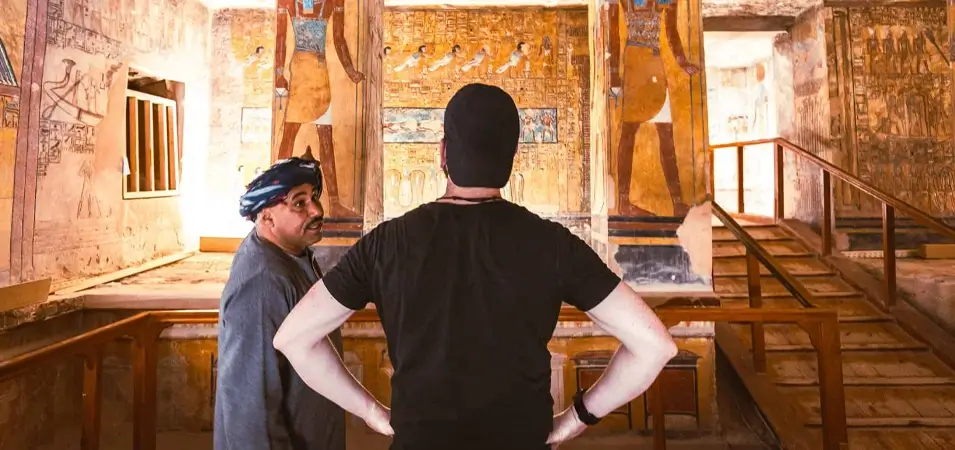
The Valley of the Kings opens every day at 6:00 AM. Closing times change with the seasons, usually around 4:00 PM in the cooler winter months from November to January, and 5:00 PM during the hotter summer months from May to August.
Tip: Try to arrive right when the site opens, not later in the morning. Tour buses from Hurghada and cruise ships usually arrive between 9:00 and 11:00 AM, and by that time, both the heat and the crowds inside the tombs increase quickly. I always tell our guests that the first ninety minutes after 6:00 AM are the best time to visit. The air is cooler, there are fewer people, and the light is better for photography where it is allowed.
How to Get There from Luxor
If you’re staying at a hotel on the East Bank, it usually takes about 30 to 45 minutes to reach the Valley, including the time to cross the Nile. Here are your main options:
- A guided tour or private driver is the easiest option. These trips often include stops at other nearby sites, such as Hatshepsut’s temple and the Colossi of Memnon.
- Hiring a taxi for the day gives you more flexibility if you prefer to travel on your own. The route crosses the Nile via the Luxor Bridge, south of the city.
- Taking the local ferry and then a taxi is the most budget-friendly way to get there. You’ll cross the Nile by public ferry, then continue by road on the West Bank.
What to Avoid: Common Visitor Mistakes
- Buying the Tutankhamun ticket by default. It’s the tomb everyone has heard of, but not the most impressive one. Decide based on what you want to see, not name recognition.
- Touching the wall paintings. Skin oils cause slow, irreversible damage. Guards enforce this, and it’s one of the quickest ways to have an awkward exchange with site staff.
- Assuming your ticket covers every tomb. It doesn’t. Plan your three picks and any add-ons before you reach the ticket window because the queue moves quickly and indecision holds up everyone behind you.
- Skipping water and sun protection. Even in winter, the valley floor traps heat and offers minimal shade until you’re inside a tomb.
- Booking a rushed 45-minute stop on an oversized day tour. The Valley deserves at least 1.5 to 2 hours for three tombs. Less than that and you’re mostly walking, not looking.
Nearby Attractions Worth Combining
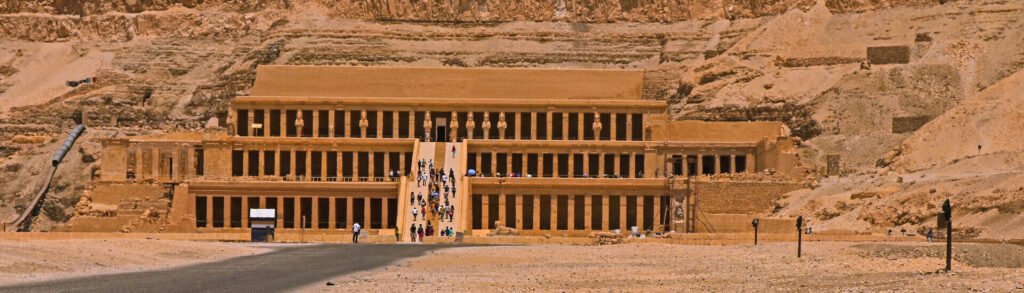
- Temple of Hatshepsut (Deir el-Bahari): This dramatic terraced mortuary temple is just a short drive from the Valley entrance.
- Colossi of Memnon: These are two enormous seated statues of Amenhotep III, usually seen on the way back toward Luxor.
- Medinet Habu: Ramesses III’s mortuary temple is less crowded than most West Bank sites and is rich in battle-scene reliefs.
- Valley of the Queens: This site is a smaller, quieter counterpart to the Valley of the Kings and is home to Nefertari’s tomb.
- Deir el-Medina: This workers’ village is where the artisans who built these tombs actually lived. It is often skipped by rushed itineraries but is worth the detour.
Preserving the Valley Today
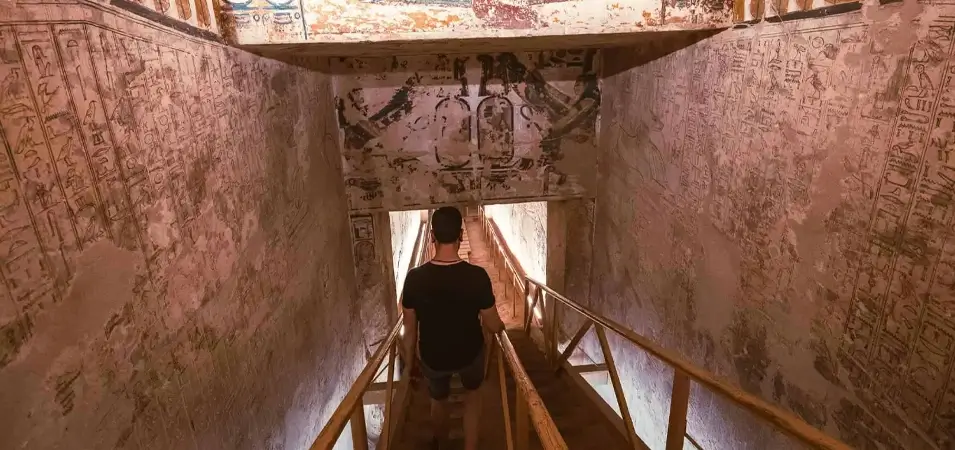
Humidity from visitors, years of exposure, and occasional flash floods all put the tombs’ pigments at risk. To help protect them, Egypt’s Ministry of Tourism and Antiquities, along with international partners, rotates which tombs are open to the public. Ancient Thebes and its Necropolis, which includes the Valley of the Kings, have been UNESCO World Heritage sites since 1979. The area is still closely watched, with flood-control and conservation efforts led by UNESCO’s World Heritage Center.
Some of the most fragile tombs, including those of Seti I and Nefertari, have been recreated as detailed digital and physical replicas. This lets visitors examine the artwork up close without causing more damage to the originals.
Frequently Asked Questions
How many tombs are in the Valley of the Kings?
There are over 60 tombs in the valley, from small unfinished pits to large multi-room complexes like KV5. Usually, about ten standard tombs and a few premium ones are open to visitors, while others are closed from time to time for conservation and to protect them from humidity.
How much does it cost to visit the Valley of the Kings?
Standard entry for foreign adults costs 750 EGP, or about $14 USD, and lets you choose three tombs from the standard list. Premium tombs like Tutankhamun, Seti I, and Ramesses V & VI need separate tickets, which cost between $4 and $37. Always check Egypt’s official tourism website for the latest prices, as they can change.
Which is the best tomb to visit in the Valley of the Kings?
Seti I (KV17) is often seen as the most impressive tomb because of its size and well-preserved artwork, but it also has the highest extra fee. If you want a great visit without paying as much, Ramesses V & VI (KV9) has amazing ceiling art for a lower price.
Is Tutankhamun’s mummy still in the Valley of the Kings?
Yes, Tutankhamun’s tomb (KV62) is the only one in the valley where the pharaoh’s mummy is still in its original burial chamber. The tomb itself is small and simply decorated compared to others in the valley.
What is the best time of day to visit the Valley of the Kings?
If you arrive when the site opens at 6:00 AM, you’ll find cooler temperatures, fewer people, and the best chance to see the tombs before big tour groups show up between 9:00 and 11:00 AM.
Can you take photos inside the tombs?
You can usually take photos with your phone (without flash) in most tombs as of 2026. Rules for some premium tombs may be different, so check at the entrance. Flash photography is not allowed anywhere because it harms the ancient colors.
Final Note from Yousef Atta
A bit of planning goes a long way at the Valley of the Kings. Choose which tombs you want to see before you reach the ticket counter, arrive early, and don’t let Tutankhamun’s fame keep you from visiting Seti I or Ramesses V & VI. When our guests return from a morning on the West Bank, they rarely talk about the famous tombs first. Instead, it’s usually the one that surprised them the most.