What is the Temple of Hatshepsut?
A mortuary temple built ~1479 BCE for Egypt’s female pharaoh, carved into cliffs at Deir el-Bahari, Luxor.
- 👑 Built for Queen Hatshepsut, one of Egypt’s few female pharaohs (r. 1479–1458 BCE)
- 🏛️ 3 terraced levels rise~30m into the cliffside — took ~15 years to build
- 🎨 Reliefs show her divine birth & famous trade expedition to Punt
- 📍 Located at Deir el-Bahari , West Bank Luxor, near Valley of the Kings
- ⚱️ Ancient name: Djeser-Djeseru, meaning “Holy of Holies”
Carved into the limestone cliffs of Deir el-Bahari on Luxor’s west bank, the Temple of Hatshepsut is one of Egypt’s most dramatic and emotionally powerful ancient sites. This complete guide covers everything you need — the full history, what to see inside, practical tips for your visit, and how to combine it with a Nile cruise.
What is the Hatshepsut Temple?
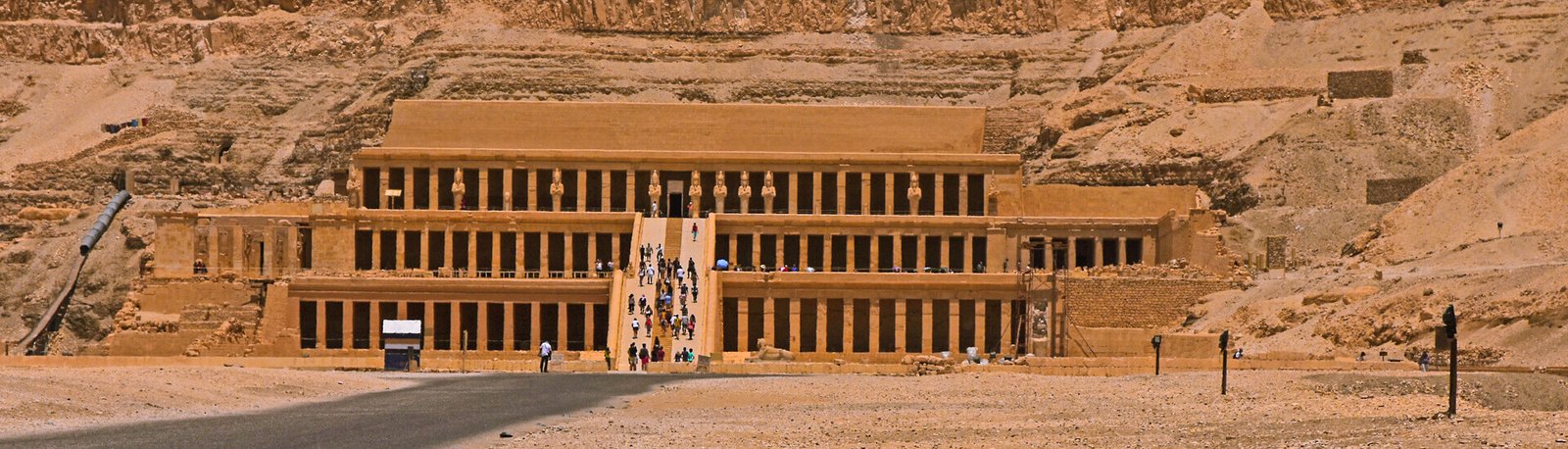
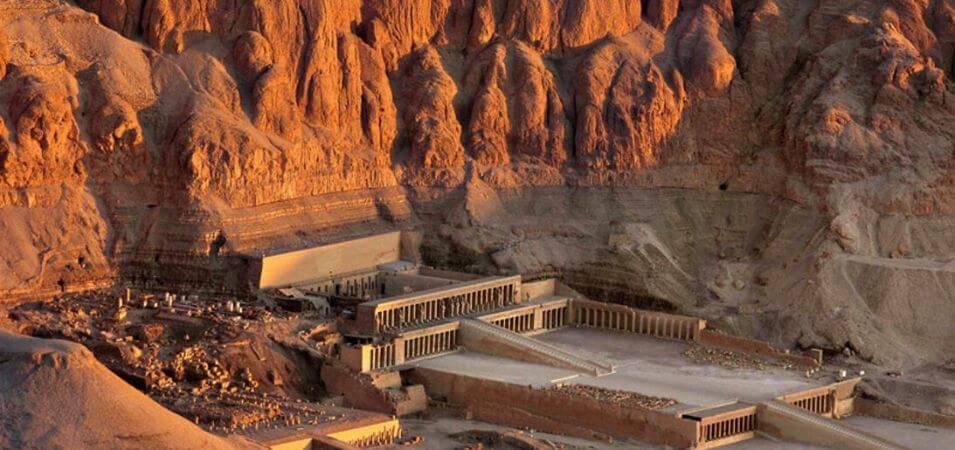
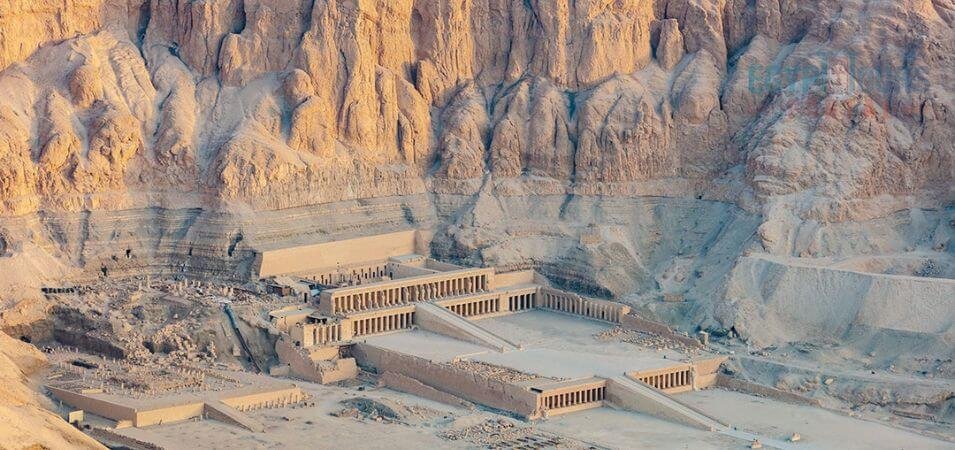
The Hatshepsut Temple — formally called the Mortuary Temple of Hatshepsut or Djeser-Djeseru (meaning “Holy of Holies” in ancient Egyptian) — is a three-tiered terraced temple built into the sheer limestone cliffs of Deir el-Bahari, on the west bank of the Nile near Luxor. It was constructed during Egypt’s 18th Dynasty, around 1479–1458 BCE.
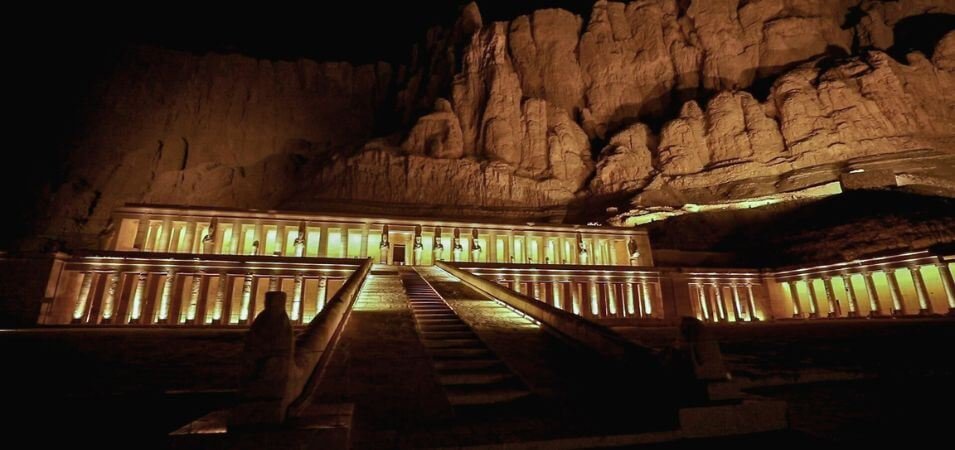
What makes it immediately striking is its architecture: three grand colonnaded terraces rise in succession against a natural amphitheater of pale rock. Where most ancient Egyptian temples are low and rectangular, Djeser-Djeseru reaches vertically, framing the desert sky. Travelers who stand at the base describe the approach as quietly awe-inspiring — the scale of the engineering and the geological backdrop is unlike anything else in Egypt.
It was built as a mortuary temple — a cult center where rituals would honor Hatshepsut after her death — and was dedicated to the god Amun. But it served a dual purpose: it was also one of the most powerful political statements in the ancient world, proclaiming the legitimacy of a female pharaoh in a civilization that had rarely seen one.
Who Was Queen Hatshepsut?
To truly appreciate this temple, you need to understand the woman who built it. Hatshepsut (born around 1507 BCE) was the daughter of Pharaoh Thutmose I. After the death of her husband and half-brother Thutmose II, she initially acted as regent for her young stepson Thutmose III — and then did something almost unheard of: she declared herself pharaoh.
She ruled for roughly 20 years, from approximately 1479 to 1458 BCE. In formal images and statues, she wore the double crown, the false beard, and the bull’s tail of pharaoh — the full visual language of male kingship — while her inscriptions used both feminine and masculine grammatical forms. Whatever the political calculation, she was an extraordinarily effective ruler.
Her reign was marked by economic prosperity, ambitious building projects throughout Egypt, and a famous trade expedition to the mysterious land of Punt (believed to be in modern-day Eritrea or Somalia). The reliefs recording that journey are among the most detailed and vivid in all of ancient Egyptian art.
After her death, Thutmose III had her images systematically erased from monuments, her name chiseled off inscriptions, and her statues smashed and buried in pits. For millennia, Hatshepsut effectively vanished from history. It was not until 1829, when hieroglyphs on these temple walls were decoded, that the world rediscovered her. Today, she is recognized as one of the most remarkable rulers in ancient Egyptian history.
When and Why Was Hatshepsut Temple Built?
Construction began around Hatshepsut’s seventh year as pharaoh and continued for approximately 15 years. The chief architect was Senenmut, her trusted steward and close confidante — a man of non-royal birth who rose to extraordinary influence. Some Egyptologists have speculated about a personal relationship between the two, though this remains unproven.
The temple served four intertwined purposes:
- Mortuary cult: After Hatshepsut’s death, priests performed daily rituals here, offering to sustain her spirit in the afterlife.
- Political legitimacy: The reliefs inside claim that Hatshepsut was the daughter of the god Amun himself — a divine birth narrative justifying her rule as pharaoh, carved in stone.
- Religious festival center: The temple was aligned with the annual Beautiful Festival of the Valley, during which the sacred bark of Amun crossed the Nile from Karnak to visit the mortuary temples on the West Bank. The temple’s east-west axis was designed specifically to receive Amun’s bark.
- Economic commemoration: The Punt expedition reliefs served as an enduring record of Hatshepsut’s trade achievements — the ancient world’s equivalent of a public announcement campaign.
Hatshepsut Temple Architecture: The Three Terraces Explained
The temple’s design is genuinely revolutionary. Senenmut drew inspiration from the earlier temple of Pharaoh Mentuhotep II (which stands directly to the left as you arrive at Deir el-Bahari) but transformed the concept into something far grander and more harmonious.
Lower terrace: the approach
The journey to the temple begins with a long processional causeway stretching approximately 400 meters from the valley temple. Originally, this was lined with sandstone sphinxes and frankincense trees brought back from Punt — the world’s first attempt at an exotic garden. The lower terrace has a broad colonnade and was once flanked by large statues of Hatshepsut. Most are gone, but the scale of the space prepares you for what lies above.
Middle terrace: where the story begins
This is where the storytelling begins in earnest. The middle portico contains two of the temple’s most important relief cycles:
- The Punt expedition reliefs (left side): Remarkably detailed panels showing the Egyptian fleet setting sail, the landscape and people of Punt (including the famous depiction of Queen Ati of Punt), and the exotic goods — incense trees, ebony, ivory, gold, and live animals — carried back to Egypt. These reliefs are unparalleled in their ethnographic detail and remain vivid after 3,400 years.
- The divine birth reliefs (right side): Here, the god Amun is depicted visiting Hatshepsut’s mother, conceiving the future pharaoh. This narrative was a direct political statement: Hatshepsut was not merely a woman who claimed the throne — she was the daughter of a god.
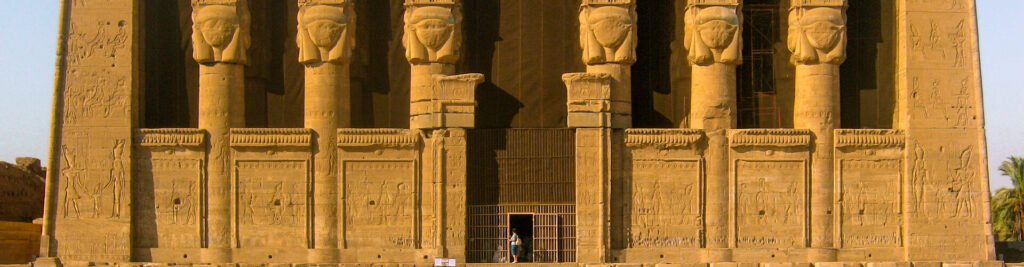
The middle terrace also contains the Hathor Chapel (on the left) — a shrine to the beloved cow goddess associated with love, beauty, music, and motherhood. Its columns are topped with Hathor-head capitals. On the right is the Anubis Chapel, dedicated to the jackal-headed god of embalming — a vital presence in any mortuary context.
Upper terrace: the sacred heart
The uppermost level is the temple’s most sacred space. An open courtyard once held mummiform statues of Hatshepsut dressed as Osiris, most destroyed by Thutmose III. At the far end, carved deep into the living rock, is the Sanctuary of Amun, the true holy of holies. Side chambers honor Hatshepsut and her father Thutmose I. A small solar chapel with an open altar aligned to the rising sun reflects how solar worship was woven into every aspect of Egyptian religion.
Local expert tip: The middle terrace Punt reliefs are best viewed in the morning when low-angle light sharpens every carved detail. Bring binoculars if you can — the upper register panels repay close attention.
The Erasure of Hatshepsut and Her Rediscovery
Following Hatshepsut’s death around 1458 BCE, Thutmose III systematically erased her from Egyptian memory: her face was chiseled from reliefs, her name scratched from inscriptions, and hundreds of statues were smashed and buried in pits across the temple grounds. Scholars continue to debate his motive — personal resentment, control of the royal succession, or a need to reassert masculine pharaonic authority? All remain plausible.
The temple survived largely because it was too massive and too important to demolish. During the early Christian era, it was converted into a Coptic Christian monastery — the name “Deir el-Bahari” actually means “the Northern Monastery” — which damaged some pagan imagery but also, paradoxically, helped protect the overall structure.
Napoleon Bonaparte’s 1798 expedition brought the temple to European attention. Systematic excavation began in the 1890s. The Polish-Egyptian archaeological mission has worked here since the 1960s and continues to make discoveries — including fragments of polychrome decoration revealing the temple was once brilliantly painted in reds, blues, and yellows.
It was not until 1829, when Jean-François Champollion analyzed the temple’s hieroglyphs, that Hatshepsut was identified. Even then, early scholars assumed a male ruler — the false beard confused them. It took decades more for historians to understand who she truly was.
Visiting Hatshepsut Temple: Complete Practical Guide
Opening hours and entry fee
The temple is open daily from 6:00 am to 5:00 pm. Entry fees are set by Egypt’s Ministry of Tourism and Antiquities and are subject to change — the standard adult ticket is approximately EGP 400–500 (roughly USD 8–10). Always verify current rates before your visit. Student discounts are available with a valid international student ID.
How to get there from Luxor
The temple sits on Luxor’s west bank, approximately 7 km from the Nile ferry landing. Your options:
- Guided tour (recommended): A licensed Egyptologist brings the reliefs and history alive in ways no guidebook can replicate. Your Nile cruise ship or Luxor hotel can easily arrange this.
- Private driver/taxi: Cross the Nile by ferry or bridge, then hire a driver on the west bank. Agree on a price before departure. A half-day round trip covering Hatshepsut Temple + Valley of the Kings typically costs EGP 600–1,000.
- Organized day tour: Many operators combine Valley of the Kings, Hatshepsut Temple, Colossi of Memnon, and Medinet Habu into one efficient full-day west bank tour — ideal for first-time visitors.
A free shuttle runs between the car park and the temple entrance. The walk from the parking to the base of the monument is approximately 400 meters across an open causeway, so comfortable closed-toe shoes are essential.
Best time to visit
The ideal months are October through April, when daytime temperatures in Luxor range from 20–28°C (68–82°F). Summer (May–September) sees temperatures regularly exceeding 40°C (104°F) — the exposed causeway and white limestone terraces intensify the heat. If you visit in summer, arrive at opening time (6:00 am) when it is relatively cool.
Whatever the season, early morning is best: the light is beautiful, most tour groups haven’t arrived, and the carvings are most vividly lit. Budget at least 90 minutes, ideally two hours.
What to wear and bring
- Light, breathable clothing — long sleeves and covered shoulders are respectful at historical and religious sites
- A wide-brimmed sun hat and high-SPF sunscreen — the exposed causeway offers zero shade
- At least 1.5 liters of water per person
- Comfortable, closed-toe walking shoes — the ramps and upper terrace have uneven stone
- Small EGP notes for tips (baksheesh) and the bazaar stalls outside the temple entrance
Photography rules
Photography is permitted in most outdoor areas. Flash photography is prohibited inside chapels and areas with painted reliefs — flash accelerates colour degradation. Tripods require a special permit. Drone photography requires advance authorisation from the Ministry of Antiquities.
Cultural tip — baksheesh: You may be approached by temple guards who offer to show you ‘special’ areas or take your photo beside reliefs. This is a longstanding local custom of tipping (baksheesh in Arabic). It is entirely your choice — if you accept, have small EGP notes ready (EGP 20–50 is typical). A polite, firm decline is also perfectly respected.
Visiting Hatshepsut Temple on a Nile Cruise
For travelers arriving by Nile cruise ship, Hatshepsut Temple is one of the most anticipated excursion stops on the entire journey. Most standard Nile cruises dock at Luxor for two nights, giving you a full day to cover the West Bank sites. A typical Luxor west bank excursion from a cruise ship covers Hatshepsut Temple, the Valley of the Kings, and the Colossi of Memnon — a combination that gives you an extraordinary cross-section of New Kingdom royal history in a single day.
On a Dahabiya Nile cruise — a traditional wooden sailing boat offering a slower, more intimate river journey — your time at Luxor is often more flexible, allowing an unhurried sunrise visit to Deir el-Bahari before the morning tour buses arrive.
For travelers planning their first cruise, our complete guide to Nile cruises in Egypt covers everything from route options to ship categories and what to expect on board. If you’d like help choosing the right cruise to include Luxor’s west bank highlights, our team is available 24/7 by phone or email.
Cruise tip: Ask your cruise operator to book the west bank excursion for 6:00 am departure. You’ll reach Hatshepsut Temple while the morning light is golden and before the large group tours arrive — a genuinely different experience from midday visits.
Nearby Attractions on Luxor’s West Bank
Hatshepsut Temple sits at the heart of the world’s greatest concentration of ancient royal monuments. When planning your visit, consider combining it with:
- Valley of the Kings — Less than 2 km away; 63 royal tombs, including Tutankhamun’s. Most full-day tours combine both sites. Our full Valley of the Kings guide is available on the site.
- Colossi of Memnon — Two 18-meter seated quartzite statues of Amenhotep III, passed on the road to/from the ferry. Free to view from the roadside and excellent for photography.
- Medinet Habu — The mortuary temple of Ramesses III, often overlooked but arguably better-preserved than Karnak, with significant original paint still visible.
- Valley of the Queens — Contains the tomb of Nefertari (wife of Ramesses II), widely considered the most beautifully decorated tomb in Egypt. Entry is limited; advance booking is essential.
- Deir el-Medina — The village of the artisans who built the royal tombs. Their own tomb decorations, made for themselves, are intimate, personal, and extraordinary
Interesting Facts About Hatshepsut Temple
- The ancient name Djeser-Djeseru means “Holy of Holies” — it was among the most sacred sites in all of ancient Egypt.
- The original sphinx-lined avenue stretched approximately 700 meters from the valley temple to the base of the monument.
- Hatshepsut’s actual tomb is not here — it is in the Valley of the Kings (tomb KV20), one of the valley’s deepest and most complex tombs, which she shared with her father, Thutmose I.
- The temple was originally painted in brilliant reds, blues, yellows, and greens. What visitors see today is bare stone — the polychrome surfaces were lost over millennia, though fragments have been recovered in recent excavations.
- A remarkable astronomical alignment: at the winter solstice sunrise, light entering the Amun sanctuary illuminates the back wall — a deliberate architectural feature connecting the pharaoh’s rebirth with the sun’s.
- The smashed statues of Hatshepsut — buried by Thutmose III in pits on the temple grounds — were rediscovered in 1926. Many are now reconstructed and displayed in the Metropolitan Museum of Art in New York.
- The structure reaches approximately 30 meters in height as its terraces ascend the cliffside.
Frequently Asked Questions
What is the Hatshepsut Temple famous for?
Hatshepsut Temple is famous for its dramatic three-tiered terraced architecture at Deir el-Bahari, for the vivid Punt expedition and divine birth reliefs on its walls, and as the monument of Queen Hatshepsut — one of ancient Egypt’s most powerful and innovative female pharaohs. It is widely considered one of the greatest architectural achievements of the New Kingdom period.
How old is the Temple of Hatshepsut?
The temple was built approximately 3,500 years ago, during the reign of Hatshepsut in Egypt’s 18th Dynasty, around 1479–1458 BCE. Construction is believed to have taken around 15 years.
What are the opening hours of Hatshepsut Temple?
The temple is open daily from 6:00 am to 5:00 pm, including weekends and public holidays. Arriving at opening time is strongly recommended to avoid peak heat and crowds.
How much does it cost to visit Hatshepsut Temple?
The standard adult entry fee is approximately EGP 400–500 (around USD 8–10), though ticket prices are regularly revised by Egypt’s Ministry of Tourism and Antiquities. Student discounts are available with a valid international student ID. Always verify current prices before your visit.
How do I get to Hatshepsut Temple from Luxor?
The temple is on Luxor’s west bank, about 7 km from the Nile ferry crossing. The most convenient options are a guided tour arranged through your hotel or Nile cruise ship, a private driver hired on the west bank, or an organized day tour combining multiple west bank sites. A free shuttle connects the car park to the temple entrance.
Can you visit Hatshepsut Temple on a Nile cruise?
Yes — Hatshepsut Temple is a standard excursion stop on most Nile cruise itineraries between Luxor and Aswan. Cruise ships typically dock at Luxor for one to two days, during which a west bank excursion covering the temple, Valley of the Kings, and Colossi of Memnon is offered. Your cruise operator will arrange transport and a licensed Egyptologist guide.
Is Hatshepsut Temple worth visiting?
Absolutely. Most travelers rank it among the highlights of their entire Egypt itinerary — many say it surpasses their expectations. The combination of extraordinary architecture, vivid ancient reliefs, and the dramatic cliff backdrop makes it one of Egypt’s most photogenic and historically rich sites. Allow at least 90 minutes to do it justice.
Where is Hatshepsut buried?
Despite building her magnificent mortuary temple at Deir el-Bahari, Hatshepsut was actually buried in the Valley of the Kings, in tomb KV20, which she had constructed to house both herself and her father Thutmose I.
What is the best time of year to visit Hatshepsut Temple?
October through April, when daytime temperatures in Luxor are manageable (20–28°C / 68–82°F). Summer months (May–September) bring extreme heat. Whatever the season, arriving at 6:00 am, when the temple opens, offers the best light and the fewest crowds.
Final Thoughts
Standing at the base of Hatshepsut’s temple, looking up at those three colonnaded terraces rising against the pale limestone cliffs, it is impossible not to feel the weight of what you’re seeing — 3,500 years of human ambition, artistry, and audacity, carved out of rock and desert.
This is not just a ruin. It is a story about a woman who claimed the most powerful position in the ancient world and then built in stone the argument for why she deserved it. That her stepson tried to erase her, and failed, feels somehow fitting. Djeser-Djeseru endured.
Whether you’re arriving from a Nile cruise, spending a day on Luxor’s west bank, or building a longer Egypt itinerary, the Temple of Hatshepsut is not a site you schedule around other priorities — it is a priority.
FAQ
What is the Temple of Hatshepsut?
It is the mortuary temple of Queen Hatshepsut, known in ancient Egyptian as Djeser-Djeseru, meaning Holy of Holies. Three colonnaded terraces rise roughly 30 metres into the limestone cliffs at Deir el-Bahari on the west bank at Luxor. It was built as a cult centre where rituals would honour her after death, and dedicated to the god Amun.
Who was Queen Hatshepsut?
Hatshepsut was born around 1507 BCE, the daughter of Pharaoh Thutmose I. After the death of her husband and half-brother Thutmose II she first acted as regent for her young stepson Thutmose III, then did something almost unheard of in ancient Egypt: she declared herself pharaoh, ruling in her own right from about 1479 to 1458 BCE.
When was the Temple of Hatshepsut built?
The temple was built during Egypt’s 18th Dynasty, roughly between 1479 and 1458 BCE, and construction took about fifteen years. That places it among the great building projects of the New Kingdom, and its unusual vertical design was as much a political statement about a female pharaoh’s legitimacy as it was a religious monument.
Why does the Temple of Hatshepsut look so different?
Most ancient Egyptian temples are low and rectangular. Djeser-Djeseru instead climbs, with three grand colonnaded terraces set one above the other against a natural amphitheatre of pale rock. The effect is architectural rather than decorative: the building answers the cliff behind it, and the scale of the engineering is what visitors remember.
What do the reliefs at Hatshepsut Temple show?
Two sequences dominate. One depicts Hatshepsut’s divine birth, presenting her as the chosen daughter of Amun and so entitled to rule. The other records her famous trading expedition to the land of Punt, showing the ships, the goods brought back and the people encountered — one of the most valuable visual records of ancient Egyptian trade that survives.
Where is Hatshepsut Temple and what else is nearby?
The temple stands at Deir el-Bahari on the west bank of the Nile at Luxor, close to the Valley of the Kings. Most west bank excursions from a Nile cruise combine the two, since they sit within a short drive of each other and both belong to the same New Kingdom funerary landscape.