
The Unfinished Obelisk in Aswan is one of Egypt’s most fascinating archaeological wonders, not because it was completed, but precisely because it wasn’t. Standing silently inside the famous granite quarries of Aswan, this colossal monument offers a rare, uncensored look into the skills, ambitions, and challenges faced by ancient Egyptian builders. Its enormous size, remarkable craftsmanship, and sudden abandonment make it a unique treasure that helps historians and travelers better understand pharaonic engineering. In this guide, you’ll discover the history, architecture, purpose, and hidden details of the Unfinished Obelisk, along with insights into its historical value and how it compares to other famous obelisks in Egypt.
Understanding the Historical Value of the Unfinished Obelisk
The historical value of the Unfinished Obelisk goes far beyond its size or location. What makes it incredibly significant is the way it documents ancient craftsmanship. Most obelisks found across Egypt and around the world were transported, erected, and decorated long before modern historians could observe their creation. That means scholars often rely on guesses and theories to understand how the ancient Egyptians carved such perfect shafts from solid granite, shaped the pointed pyramion, or transported these monoliths across great distances.
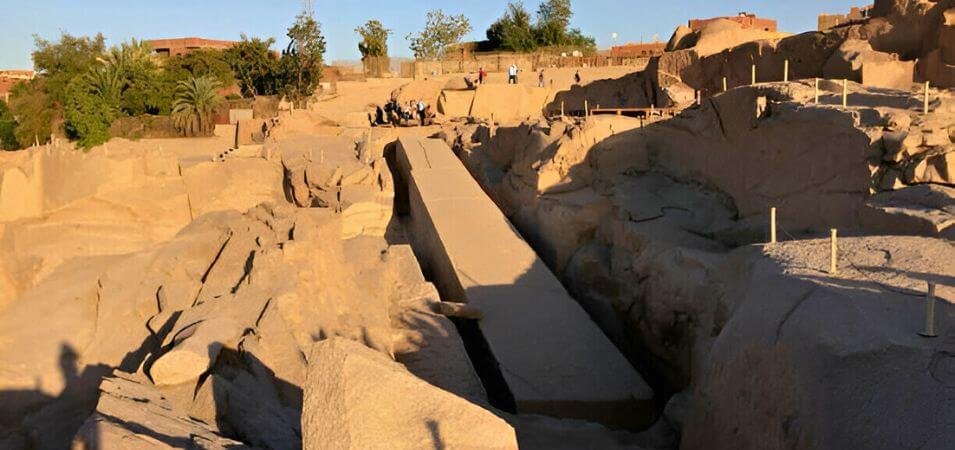
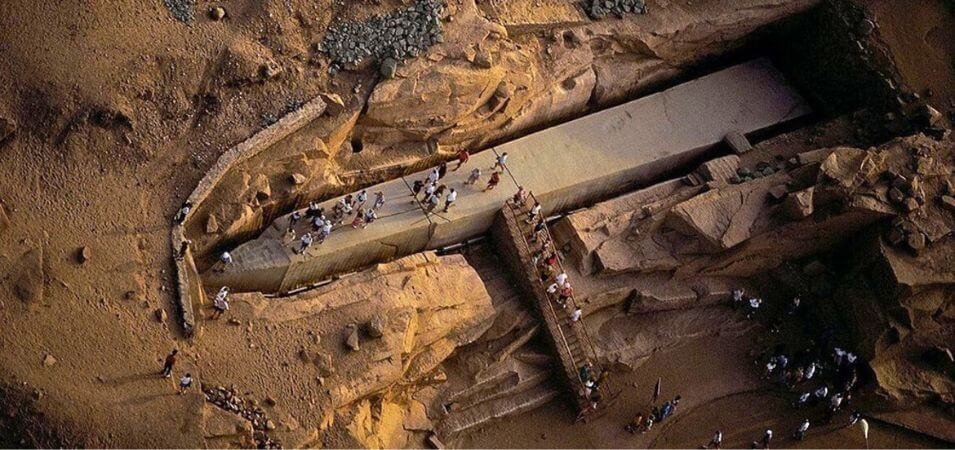
The Unfinished Obelisk changes this entirely. Because it was abandoned mid-carving, it remains attached to the bedrock of the quarry, almost like a frozen moment in time. Ancient tool marks still cover the surface, revealing the repetitive chiseling technique used by workers. The cracks that halted the project are still visible, offering clear evidence of the structural failures builders encountered.
This monument essentially became an open-air classroom for archaeologists. By studying it, experts confirmed which tools were used, how workers organized labor, and how quarrying progressed in step-by-step phases. The Unfinished Obelisk is not only a historic artifact; it is a direct transcript of ancient engineering, preserved naturally for thousands of years.
What Do You Know About the Unfinished Obelisk?
What most people know about the Unfinished Obelisk is that it is the largest known ancient obelisk ever attempted. Yet the story behind it is much deeper. Commissioned during the reign of Queen Hatshepsut in the 18th Dynasty, around 1500 BCE, the obelisk was intended to be a monumental symbol celebrating her power and divine connection to the gods. If completed, it would have weighed an astonishing 1,200 tons—more than any single stone monument ever transported in ancient Egypt.
The quarry itself was a thriving industrial site. Workers used dolerite stones to pound and shape the granite, gradually carving the obelisk’s body from one enormous piece of bedrock. The design and dimensions illustrate a high degree of precision. Even without being completed, the obelisk reflects the mathematical and architectural knowledge the Egyptians possessed. Its surfaces were intended to be polished smooth after transport, and its pointed peak would have been capped with electrum—a mixture of gold and silver—to shine brilliantly in the sun.
However, as carving progressed, the stone developed long, deep cracks. These fractures made it impossible to continue, forcing workers to abandon the entire project after years of effort. Rather than remove the damaged stone or reshape it, the Egyptians left it exactly where it was. Today, the cracks remain part of the narrative, showing visitors the vulnerability of even the most advanced ancient craftsmen.
Walking around the obelisk, visitors can clearly see the narrow trenches carved around it. These trenches were meant to free the monolith from the quarry bed, leaving enough space for workers to use wedges and tools underneath. This method demonstrates how Egyptians quarried such massive structures long before the existence of cranes or machinery. The Unfinished Obelisk may not have reached its intended destination, but it tells the story of innovation, labor, precision, and ambition.
Architecture and Craftsmanship of the Unfinished Obelisk
The architectural design of the Unfinished Obelisk is a testament to the expertise of ancient Egyptian stonemasons. Obelisks were not merely decorative; they held symbolic importance connected to the sun god Ra. Their slender shape, rising sharply into the sky, represented the rays of the sun, and their placement at temple entrances was intended to channel divine energy into sacred spaces.
The architects of the Unfinished Obelisk followed similar principles. The structure maintains perfect symmetry, with smooth sides planned to taper gracefully toward the top. Even in its unpolished form, the precision of the carving is noticeable. Along the length of the monument, countless tool marks remain intact, offering a rare view into the construction process. These marks show how workers started by loosening the rock with dolerite balls, creating small pits that slowly formed into wider channels.
Had it been completed, the obelisk would have reached approximately 42 meters in height—nearly a third taller than any standing ancient obelisk in Egypt today. Its base, still embedded in the quarry floor, reveals the exact stages of separation. The design reflects the architectural rhythm of obelisk construction: smooth sides, gradual tapering, and a sharply pointed pyramion intended to glow as sunlight struck it.
This monument also highlights the Egyptians’ mastery of logistics. Transporting such a structure from Aswan to Luxor, where Hatshepsut planned to erect it, would have required advanced knowledge of buoyancy, manpower organization, and river navigation. The architecture of the obelisk cannot be separated from the complex engineering that would have followed.
The Purpose and Symbolism Behind Ancient Egyptian Obelisks
To understand the purpose of the Unfinished Obelisk, it’s important to recognize why obelisks were constructed in the first place. In ancient Egyptian belief, obelisks symbolized a physical connection between the earth and the sun. They were placed at temple entrances to honor the gods, especially Ra, and to represent the enduring power of the pharaoh.
Queen Hatshepsut was known for her bold architectural projects, and completing the world’s largest obelisk would have been a powerful demonstration of her authority. Obelisks acted not only as religious symbols but also as political tools. Pharaohs often commissioned them to commemorate victories, celebrations, or religious dedications. The Unfinished Obelisk, therefore, represents Hatshepsut’s ambition to leave a remarkable legacy.
Even though the obelisk was never erected, its purpose remains clear: it was meant to be a monumental testament to divine kingship. Today, it continues to fulfill a different purpose—educating visitors about the remarkable abilities of ancient Egyptian builders.
Fascinating Facts About the Unfinished Obelisk
One of the most interesting facts about the Unfinished Obelisk is that it is carved from rose granite, a material famous for its durability and beauty. Aswan granite was prized throughout Egypt and used in temples, sarcophagi, statues, and architectural columns.
Another captivating detail is the sheer scale of what was attempted. No ancient civilization ever attempted to carve a single block of stone this large. Even today, modern engineers acknowledge that transporting such an object with ancient tools would have been a nearly unimaginable feat. The fact that workers intended to move the obelisk hundreds of kilometers demonstrates extraordinary confidence and ingenuity.
Some visitors are surprised to learn that archaeologists discovered multiple other half-finished monuments within the Aswan quarries. These remains show that the unfinished obelisk was not a unique failure but part of a larger tradition of ambitious stonework.
Other Obelisks in Egypt and Nearby Attractions
While the Unfinished Obelisk is the most famous incomplete monument in Egypt, the country is home to many completed obelisks that reflect the brilliance of ancient architecture. In Luxor, the Luxor Temple once hosted two magnificent obelisks; today, only one remains, standing proudly at the entrance. Its twin now stands in the Place de la Concorde in Paris, transported during the 19th century.
Another impressive example is the Lateran Obelisk, originally from the Temple of Karnak. It is the tallest ancient obelisk still standing and, like many Egyptian monuments, was later transported to Rome. The Karnak Temple complex itself features another standing obelisk belonging to Hatshepsut, which remains one of the tallest surviving anywhere in the world.
Visitors exploring Aswan can enjoy many nearby attractions in addition to the Unfinished Obelisk. The Philae Temple, dedicated to the goddess Isis, is one of the most enchanting temples in Egypt. Its island setting creates an almost dreamlike atmosphere. The High Dam and Lake Nasser also draw travelers, offering insight into modern engineering accomplishments that shaped Egypt’s landscape.
Other landmarks connected to ancient obelisks include the temples at Karnak and Luxor, where many of these striking structures originally stood. Exploring these sites helps visitors understand the cultural and spiritual importance of obelisks in temples and sanctuaries across Egypt.
Final Thoughts on the Legacy of the Unfinished Obelisk
The Unfinished Obelisk stands as one of Egypt’s greatest archaeological treasures, not because it was completed but because it provides an unparalleled look into ancient engineering. It reveals how workers carved stone, how pharaohs planned monumental architecture, and how ambitious the ancient Egyptians truly were. The historical value of the unfinished Egypt obelisk continues to grow as researchers study its surface, tool marks, and environment.
Visiting this site is like stepping behind the scenes of a 3,500-year-old construction project. It brings history to life in a way that polished monuments and finished temples cannot. Whether you’re passionate about ancient engineering, fascinated by Egyptian history, or simply curious about the story behind this massive monument, the Unfinished Obelisk offers an unforgettable journey into the past.
