
The Tutankhamun Tomb remains one of the most extraordinary archaeological discoveries in human history. Hidden for more than 3,000 years beneath the sands of the Valley of the Kings, the tomb of the young pharaoh revealed treasures, mysteries, and architectural details that reshaped our understanding of ancient Egypt. From its unexpected discovery in 1922 to the glittering gold artifacts found within, Tutankhamun’s resting place continues to fascinate travelers, historians, and researchers alike.
In this in-depth guide, you’ll explore the history, architecture, purpose, interior design, and remarkable treasures of the Tutankhamun Tomb while maintaining a user-friendly narrative crafted for both SEO value and human readability.
The Discovery of the Tutankhamun Tomb
The discovery of the Tutankhamun Tomb in 1922 is often described as the greatest archaeological moment of the 20th century. For years, British excavator Howard Carter searched tirelessly in the Valley of the Kings, convinced that an undiscovered tomb still lay hidden there. After funding from Lord Carnarvon almost ran dry, Carter returned for one final season—only to uncover a staircase beneath some rubble that would change history.
When Carter first peered into the tomb through a small opening, Lord Carnarvon asked if he could see anything. Carter’s answer would become legendary: “Yes, wonderful things.” The flickering light revealed golden statues, furniture, jewelry, and ritual items untouched by ancient thieves. Unlike many royal tombs that were plundered in antiquity, the Tutankhamun Tomb remained almost entirely intact, preserving an astonishing collection of over 5,000 artifacts.
This moment electrified the academic world and captivated the global public, sparking a renewed fascination with ancient Egypt known as “Tutmania.” Newspapers chronicled each new find, and the discovery reshaped the discipline of Egyptology forever.
Where Tutankhamun Tomb located
The Tutankhamun Tomb, officially known as KV62, is located in Egypt’s famous Valley of the Kings, on the west bank of the Nile River near Luxor. This area served as the burial ground for New Kingdom pharaohs, nobles, and high priests. The valley was selected for its natural pyramid-like peaks, which offered symbolic protection to the deceased.
What makes Tutankhamun’s location especially interesting is its proximity to the tomb of Ramesses VI, whose construction debris helped hide the entrance to KV62 for centuries. This accidental burial beneath ancient rubble was one of the key reasons the tomb escaped looting, preserving its golden treasures until modern times. Visitors today can enter the tomb and see the burial chamber, the famous murals, and even the mummy of Tutankhamun, which remains inside to ensure its preservation.
The History Behind Tutankhamun’s Tomb
Tutankhamun ruled during the 18th Dynasty, a period marked by dramatic religious changes. His father, Akhenaten, had attempted to replace Egypt’s traditional gods with the worship of the Aten, the sun disk. When Tutankhamun became king at around nine years old, the young pharaoh restored the old religion and returned power to the priesthood.
Despite his significant political corrections, Tutankhamun’s reign was short. He died around age nineteen, under circumstances that remain debated—ranging from illness to accident to genetic complications.
Because of his sudden death, the tomb was likely prepared in haste. Compared to the monumental tombs of other pharaohs, Tutankhamun’s is much smaller and simpler. Yet this very simplicity preserved its treasures. Since the burial seemed unimportant at the time, looters may have overlooked it, allowing it to remain hidden for millennia.
His obscurity in ancient history ironically contributed to his global fame today. Without a grand reputation during his life, no record of his tomb’s location survived, and so his resting place waited undisturbed until Carter’s discovery.
The Architecture and Purpose of the Tomb
Although the Tutankhamun Tomb is modest compared to other royal burial sites in the Valley of the Kings, its architecture still follows key elements designed to guide the pharaoh from the world of the living to the afterlife.
The tomb contains a simple layout with four main rooms: the Entrance Corridor, the Antechamber, the Annex, and the Burial Chamber. Each room played a symbolic and functional role.
The Entrance Corridor slopes downward, representing the descent into the land of the dead. The Antechamber served as a storeroom for daily-use items that the king would need on his eternal journey, such as chariots, beds, and ritual objects. The Annex held smaller, more delicate items, including oils, ointments, and food offerings, carefully packed to accompany the pharaoh.
The Burial Chamber is the spiritual heart of the tomb. Its walls are decorated with vivid yellow backgrounds and scenes depicting Tutankhamun’s transition into the afterlife. The chamber contains the nested shrines and sarcophagi that protected the king’s mummy. The final resting place of Tutankhamun remains inside the chamber today, making it one of the few royal mummies still in its original tomb.
Nearby Attractions to Explore After Visiting Tutankhamun’s Tomb
A visit to the Tutankhamun Tomb in the Valley of the Kings naturally invites travelers to explore more of Luxor’s incredible ancient landmarks. Just steps away from KV62, you’ll find the grand tombs of powerful pharaohs such as Seti I and Ramses VI, each offering richly decorated chambers that show the evolution of funerary art and architecture. These neighboring tombs allow visitors to compare royal burials from different reigns and appreciate how unique Tutankhamun’s small but treasure-filled resting place truly is.
Not far from the Valley of the Kings sits the iconic Hatshepsut Temple, a magnificent terraced structure carved into towering limestone cliffs. Its elegant colonnades and sweeping ramps showcase the architectural brilliance of Egypt’s only female pharaoh. On the same west bank, you can also visit the Colossi of Memnon, two massive seated statues that once marked the entrance to Amenhotep III’s sprawling mortuary temple.
Across the river on the east bank, the stunning Karnak Temple Complex awaits—one of the largest religious sites ever built. Its hypostyle hall, towering obelisks, and sacred lake offer a deep look into temple life during the New Kingdom, the same era Tutankhamun ruled. A short drive south brings you to Luxor Temple, beautifully illuminated at night and connected to Karnak by the ancient Avenue of Sphinxes. These nearby attractions help bring Tutankhamun’s world to life and make a visit to his tomb part of a deeper journey through Egypt’s history, art, and spiritual legacy.
Tutankhamun Tomb Gold: A Treasure Beyond Imagination
Nothing symbolizes the richness of ancient Egyptian burial practices more than the gold found inside Tutankhamun’s tomb. More than 100 pieces of jewelry, statues, amulets, and ceremonial objects made of gold were unearthed during the excavation.
Gold in ancient Egypt was associated with the flesh of the gods, representing eternity and divine radiance. For a pharaoh, being surrounded by gold was a way of transforming into a god after death.
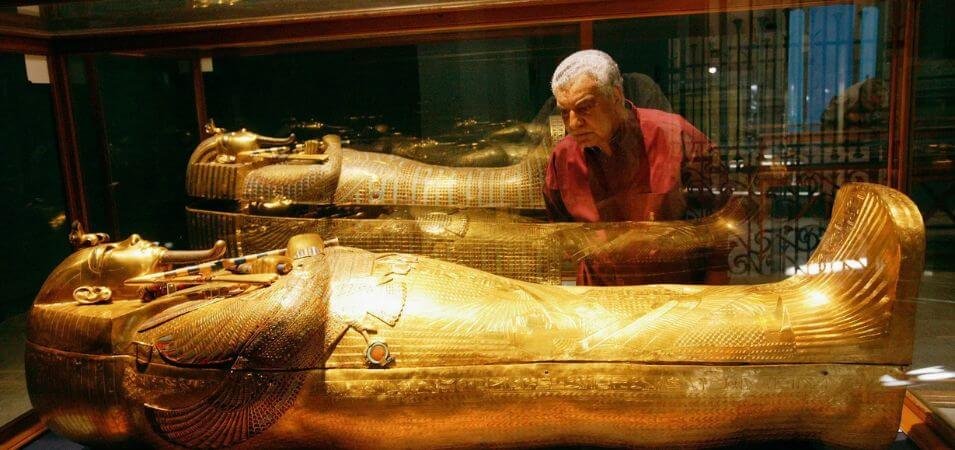
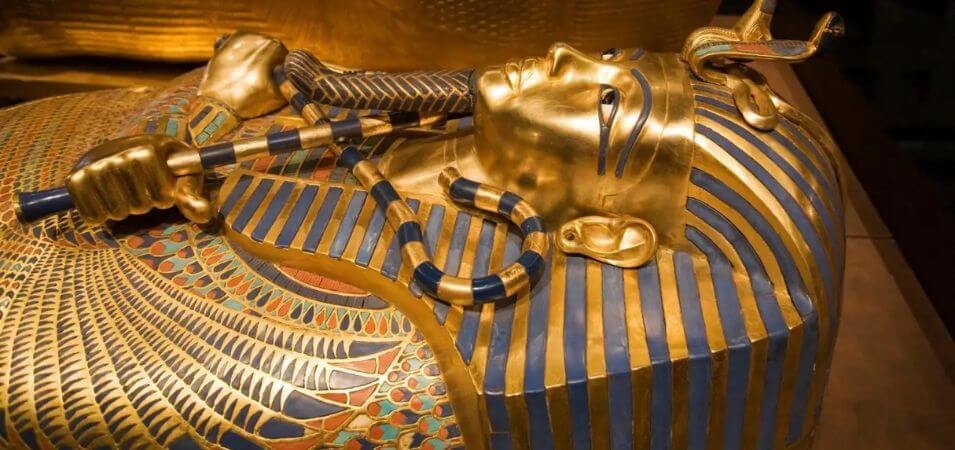
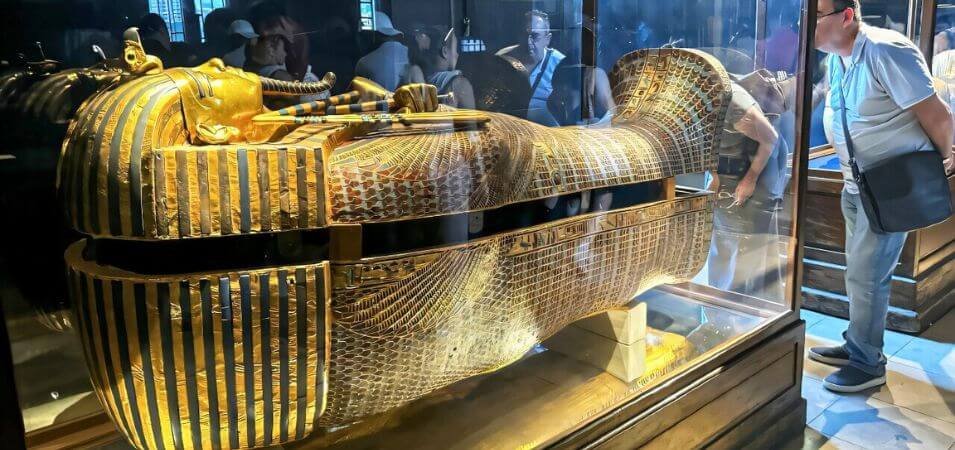
Carter found golden thrones, chariots, shrines, and even sandals made of gold. The golden throne of Tutankhamun, decorated with an intimate scene of the king and queen, is one of the most beautiful examples of Egyptian artistry. The solid gold inner coffin, weighing over 100 kilograms, is the most astonishing discovery of all. Each golden artifact served a purpose, whether for protection, status, ritual power, or symbolic rebirth. Together, they painted a portrait of royal life, belief, and ambition during Egypt’s 18th Dynasty.
Fascinating Facts About the Tutankhamun Tomb
The Tutankhamun Tomb is filled with captivating facts that continue to surprise scholars and visitors alike. The tomb’s small size reveals that it was likely adapted from a non-royal burial. Many objects inside were repurposed from other individuals, possibly due to the rush following the king’s sudden death.
The famous “curse of the pharaohs” emerged after several individuals connected to the excavation died under unusual circumstances. While scientists attribute the deaths to natural causes or coincidence, the legend adds a layer of intrigue to the tomb’s history.
Another fascinating detail is that the tomb contained jars of wine labeled with harvest years, offering insight into ancient Egyptian agriculture. Even Tutankhamun’s clothing, including linen kilts and ceremonial garments, survived the centuries with remarkable preservation. The tomb also revealed furniture, musical instruments, toys, and board games, illustrating that the afterlife was imagined as a continuation of earthly life—one where comfort, entertainment, and personal possessions remained essential.
Why Tutankhamun’s Tomb Still Matters Today
More than a century after its discovery, the Tutankhamun Tomb continues to shape our understanding of ancient Egypt. It offers an almost complete picture of royal burial customs, craftsmanship, daily life, and religious beliefs during the New Kingdom.
For Egyptologists, the tomb provides an invaluable archive of objects untouched by time. For tourists, it offers a rare chance to step into the world of a pharaoh exactly where he was laid to rest. For the world, it remains a symbol of human curiosity, perseverance, and the thrill of uncovering the past.
The legacy of the discovery reminds us that even the smallest tombs can hold the greatest treasures—and that history sometimes hides its most impressive stories in the most unexpected places.
