
The Abu Simbel Temples stand as one of Egypt’s most extraordinary achievements in art, engineering, and ancient architecture. Carved directly into the cliffs along the western bank of Lake Nasser, these monumental structures created by Pharaoh Ramses II continue to amaze visitors with their sheer size, historical significance, and the breathtaking story of how they were saved from rising waters. This guide explores the temples’ history, architecture, purpose, relocation, interesting facts, and what to expect when visiting, giving travelers a complete and friendly overview.
The History of the Abu Simbel Temples
The Abu Simbel Temples’ history begins in the 13th century BC, during the reign of Ramses II, one of Egypt’s most powerful and celebrated pharaohs. Ramses II built the Great Temple to honor the gods Amun-Ra, Ptah, Ra-Horakhty, and himself. It was also designed to project Egyptian power deep into Nubia, a region Egypt ruled for centuries. The smaller temple, situated a short walk away, was dedicated to Queen Nefertari, Ramses II’s beloved wife, and the goddess Hathor.
Despite being carved in the middle of the desert, the temples were not forgotten. Ancient graffiti from Greek and Roman visitors shows that Abu Simbel continued to attract travelers long after Egypt’s pharaonic age had passed. The temples eventually became buried in sand, with only the heads of the colossal statues visible until the 19th century, when Swiss explorer Johann Ludwig Burckhardt rediscovered them. His findings inspired further exploration, cementing the temples as archaeological treasures.
Architecture and Design of the Abu Simbel Temples
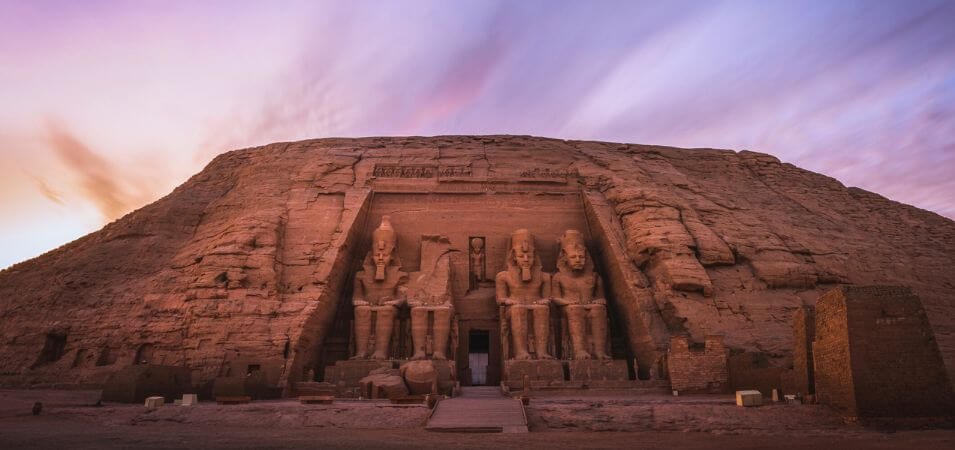
The architecture of the Abu Simbel Temples combines artistic mastery with celestial precision. The Great Temple facade is dominated by four colossal seated statues of Ramses II, each rising over 20 meters high. These statues guard the entrance, creating a dramatic first impression that leaves every visitor in awe.
Inside, the temple extends through a series of halls and chambers carved entirely from the rock. The Hypostyle Hall is supported by eight massive Osiride pillars, each shaped like Ramses II in the god Osiris’s pose. Further inside lies the sanctuary, where statues of three gods and Ramses II sit side by side. This chamber is the heart of the temple and plays a crucial role in one of the site’s most famous phenomena.
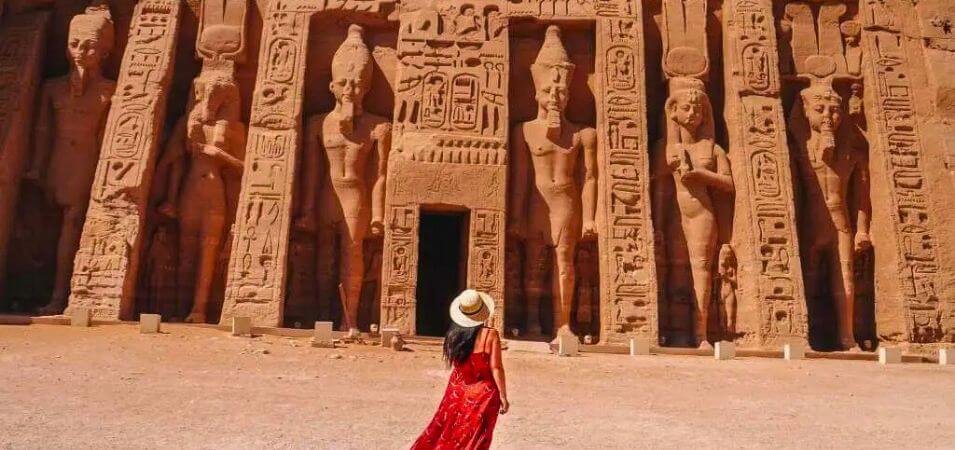
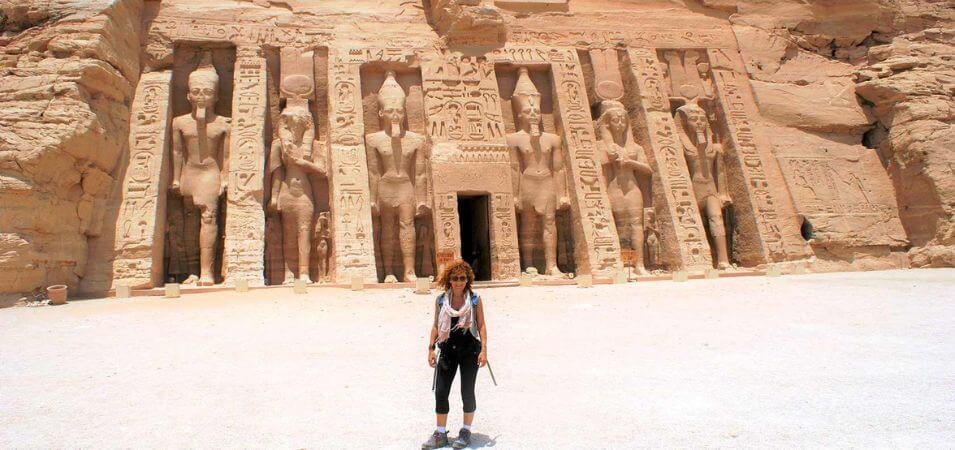
The smaller temple dedicated to Queen Nefertari has a façade adorned with six statues—four of Ramses II and two of Nefertari. Unusually for ancient Egypt, the queen is depicted at the same size as the pharaoh, symbolizing her elevated status and the deep affection Ramses II had for her.
The Sun Alignment Phenomenon
One of the most famous Abu Simbel Temple facts is the biannual solar alignment. Twice a year—around February 22 and October 22—sunlight penetrates 60 meters into the Great Temple to illuminate the statues in the sanctuary. All but one statue, that of Ptah, the god of darkness, is lit by the rising sun.
This incredible architectural feat demonstrates the ancient Egyptians’ advanced understanding of astronomy and engineering. Thousands of people gather every year to witness the event, making it one of the most magical experiences in Egypt.
The Remarkable Abu Simbel Relocation
Perhaps the most dramatic chapter in the site’s modern history is the Abu Simbel relocation. In the 1960s, the construction of the Aswan High Dam created a massive reservoir—Lake Nasser—that threatened to submerge the temples completely. Losing Abu Simbel would have been a cultural catastrophe, prompting an international rescue campaign spearheaded by UNESCO.
The relocation process was unprecedented. Engineers decided to cut the temples into large blocks weighing up to 30 tons each. These pieces were then lifted and reassembled 65 meters higher and 200 meters inland from their original location. Even the orientation was preserved, so the sun alignment would still occur.
The relocation took four years and remains one of the most ambitious archaeological engineering projects ever completed. Abu Simbel’s successful rescue became the inspiration for global heritage protection efforts and contributed to the founding of the UNESCO World Heritage list.
Exploring the Interior of the Temples
Stepping inside the Abu Simbel Temples is like walking backward in time. The walls are decorated with detailed reliefs depicting Ramses II’s military victories, religious ceremonies, and offerings to the gods. The Battle of Kadesh, one of the most famous military campaigns of the ancient world, is illustrated in vivid detail along the walls of the Great Temple’s Hypostyle Hall.
The ceilings are adorned with stars and protective symbols, while the inner chambers house artwork that has survived thousands of years. In the smaller temple, the interior celebrates Nefertari and the goddess Hathor through elegant reliefs that highlight beauty, femininity, and divine protection.
The carvings retain their original color in some areas, offering a rare glimpse into how vibrant ancient Egyptian temples once were.
Abu Simbel Temples Facts That Will Surprise You
Many travelers arrive at Abu Simbel Temples already impressed, but the site still holds surprises. One lesser-known fact is that the temples were not built for daily worship but to showcase Ramses II’s power and divine connection. Another fascinating detail is that during the relocation, experts successfully preserved the temples’ acoustics, meaning chants and sounds still echo as they would have over three millennia ago.
Visitors are also often amazed by how precise the carvings are, despite being made in solid rock and deep within the cliffs. Even more astonishing is the symmetrical layout, as the hallways align perfectly from the entrance to the sanctuary with millimeter accuracy.
Abu Simbel Temples Reviews: What Travelers Say
Modern travelers consistently rate the Abu Simbel Temples as one of the most unforgettable experiences in Egypt. Many reviews highlight the incredible moment when the giant statues emerge slowly in the sunrise light, especially for those who arrive early. Visitors often describe the site as more impressive than photos suggest, noting that the scale and craftsmanship are impossible to capture fully in images.
Tourists also comment on the peaceful atmosphere. Despite being a popular attraction, the remote location means it never feels overwhelmingly crowded. Visitors describe the trip to Abu Simbel—whether by road, flight, or cruise—as fully worth the effort. It is commonly listed among the must-see attractions in Egypt alongside the Pyramids of Giza, Karnak Temple, and the Valley of the Kings.
Nearby Attractions Worth Exploring
A visit to Abu Simbel often includes nearby attractions that complement the experience. Travelers visiting from Aswan can explore highlights such as the Temple of Philae, dedicated to Isis, and the Unfinished Obelisk, which offers a behind-the-scenes look at ancient stone-carving techniques. The Aswan High Dam itself is another important site connected to the story of Abu Simbel’s rescue. For those traveling along Lake Nasser, other Nubian monuments—including Amada Temple, Wadi es-Sebua, and the Temple of Derr—offer additional opportunities to explore Egypt’s southern heritage.
Why the Abu Simbel Temples Matter Today
The Abu Simbel Temples are more than archaeological monuments; they are powerful symbols of ancient Egyptian mastery and modern global cooperation. They stand as reminders of a civilization that thrived on innovation, artistry, and cosmological understanding. At the same time, the relocation project demonstrates what humanity can accomplish when nations work together to protect cultural heritage.
Today, Abu Simbel is a UNESCO World Heritage site and continues to attract visitors from around the world who want to witness one of the most extraordinary creations of the ancient past.
Conclusion
A journey to the Abu Simbel Temples is an unforgettable encounter with history, architecture, mythology, and human achievement. From the majestic statues carved deep into the cliffs to the incredible story of their relocation, every part of Abu Simbel tells a tale that spans thousands of years. Whether you’re fascinated by Egyptian history, drawn to monumental architecture, or simply seeking a travel experience unlike any other, Abu Simbel is a destination that captures the imagination and stays with you long after your visit.
