
The Valley of the Kings is one of the world’s most awe-inspiring archaeological wonders—a timeless necropolis carved into the golden cliffs of Luxor’s West Bank. Once the eternal resting place of Egypt’s greatest pharaohs, it remains a silent witness to the power, art, and spirituality of the New Kingdom era.
Nestled opposite modern-day Luxor, the valley is more than a burial ground; it’s a gateway into ancient Egyptian beliefs about life, death, and the afterlife. For centuries, it has lured explorers, archaeologists, and travelers eager to unravel its mysteries and walk the same paths as Ramses, Seti, and Tutankhamun.
The Valley of the Kings, Egypt – A Journey Through Time
The Valley of the Kings lies on the west bank of the Nile, opposite the ancient city of Thebes—now Luxor. The ancient Egyptians chose this spot deliberately. In their belief, the west symbolized death, as the sun set in the western horizon before being “reborn” each morning.
This sacred valley became the final resting place for Egypt’s New Kingdom pharaohs—rulers who sought to secure immortality by hiding their tombs from robbers and desecration. Unlike the grand pyramids of earlier dynasties, these tombs were carved deep into limestone cliffs, designed for secrecy and spiritual protection.
Just a short distance away are other remarkable attractions that form part of the ancient Theban Necropolis:
- The Temple of Hatshepsut at Deir el-Bahari, an architectural masterpiece rising dramatically from the desert cliffs.
- The Colossi of Memnon, two towering statues that once guarded the entrance to Amenhotep III’s mortuary temple.
- The Ramesseum and Medinet Habu, both monumental temples honoring Egypt’s warrior pharaohs.
Together, these sites create a breathtaking landscape that tells the story of Egypt’s golden age.
When Was the Valley of the Kings Built?
Construction of the Valley of the Kings began around 1550 BCE, during the reign of Pharaoh Thutmose I of the 18th Dynasty. Over the next 500 years, more than 60 tombs were excavated for pharaohs, queens, and nobles of the 18th, 19th, and 20th dynasties.
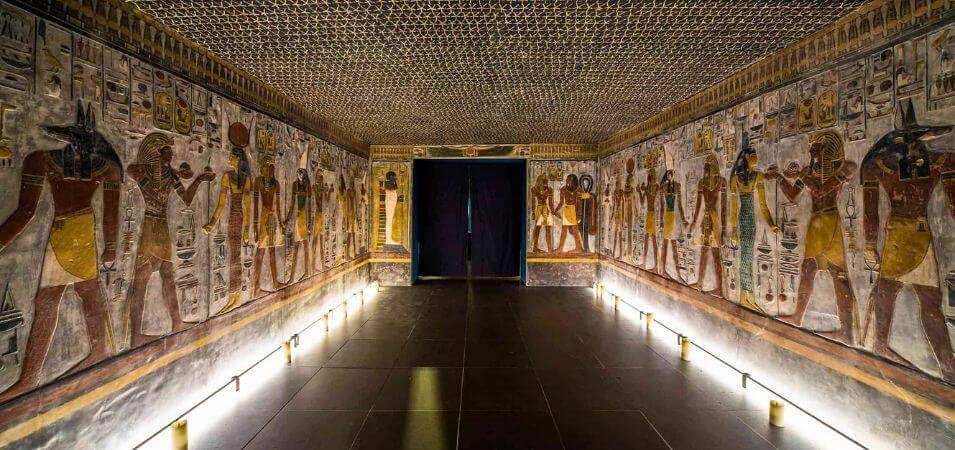
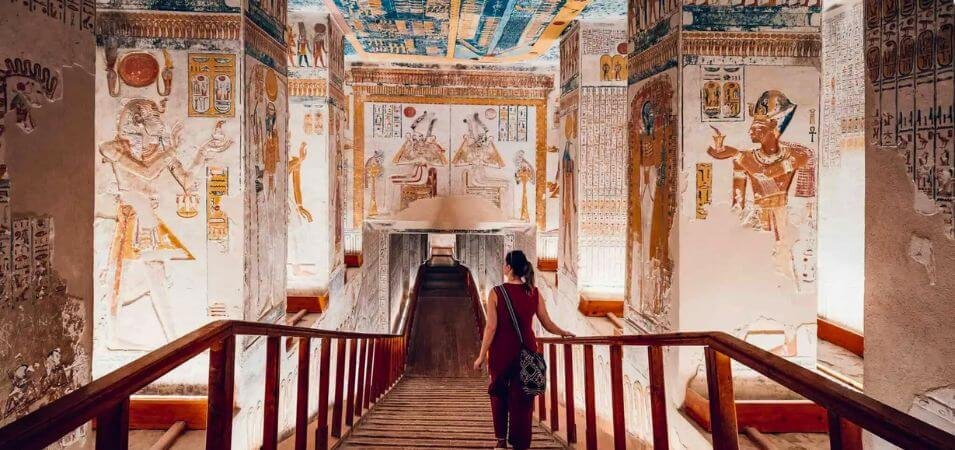
Each tomb represented both an engineering marvel and a spiritual journey. The builders—skilled artisans from the nearby village of Deir el-Medina—worked tirelessly to carve intricate passageways, paint sacred texts, and decorate walls with scenes from the Book of the Dead, Book of Gates, and Book of Caverns.
These were not just burial chambers; they were maps of the afterlife, guiding the pharaoh’s soul safely through the underworld to eternal rebirth.
Why Was the Valley of the Kings Built?
The valley was created out of necessity and belief. Earlier pyramids, like those at Giza, had made pharaohs’ treasures vulnerable to thieves. To protect their kings in death, the Egyptians sought a hidden, isolated place that could be guarded and controlled.
Spiritually, the Valley of the Kings embodied the journey of resurrection. Each tomb was a symbolic universe, with corridors representing the path of the sun god Ra through night and day. The buried treasures were not for display but for use in the afterlife—everything a ruler might need to live forever among the gods.
The site also aligned with Egypt’s religious geography: the nearby Deir el-Bahari cliffs were believed to resemble a pyramid shape, echoing the concept of ascension and eternal life.
Who Was Buried in the Valley of the Kings?
More than 60 royal tombs have been discovered, belonging to some of Egypt’s most iconic rulers. Among them are:
- Tutankhamun (KV62) – the “boy king” whose tomb, discovered by Howard Carter in 1922, astonished the world with its dazzling treasures and nearly intact contents.
- Ramses II (KV7) – one of Egypt’s most powerful pharaohs, known for his reign of 66 years and monumental temples like Abu Simbel.
- Seti I (KV17) – builder of one of the longest and most beautifully decorated tombs in the valley.
- Thutmose III (KV34) – a brilliant military leader whose tomb is famous for its symbolic, almost minimalist art style.
- Amenhotep II (KV35) – whose tomb later served as a secret royal cache, hiding the mummies of several other kings for safekeeping.
Not all tombs belonged to pharaohs; some were for queens, princes, and high officials who served Egypt’s rulers. The nearby Valley of the Queens complements this royal burial ground, housing the tombs of queens such as Nefertari, whose resting place is considered one of Egypt’s most beautiful.
How Many Tombs Are in the Valley of the Kings?
To date, archaeologists have recorded over 60 tombs in the valley—ranging from small, unfinished chambers to elaborate complexes stretching deep into the rock.
The tombs are numbered with the prefix “KV” (for King’s Valley). Some of the most notable include:
- KV5, belonging to the sons of Ramses II, one of the largest tombs with over 120 chambers.
- KV17, Seti I’s masterfully decorated tomb.
- KV62, Tutankhamun’s world-famous burial site.
Despite more than two centuries of exploration, archaeologists continue to make new discoveries. Ground-penetrating radar and modern imaging technology have revealed unexplored chambers, suggesting that the valley may still hide unknown tombs.
When Was the Valley of the Kings Discovered?
Although known to locals for centuries, the scientific rediscovery of the Valley of the Kings began in the 18th century when European explorers arrived in Egypt. Systematic excavation began in the 19th century, led by pioneering Egyptologists like Giovanni Belzoni and Jean-François Champollion.
However, the most significant event occurred in 1922, when Howard Carter, funded by Lord Carnarvon, uncovered the sealed tomb of Tutankhamun. The discovery of the young pharaoh’s golden sarcophagus, jewelry, chariots, and funerary mask sparked a worldwide fascination with ancient Egypt that endures today.
10 Fascinating Facts About the Valley of the Kings
- The valley was used for over 500 years, from about 1550 to 1070 BCE.
- It contains over 60 tombs, each with unique architecture and decoration.
- The workers’ village of Deir el-Medina housed artisans who built and painted the tombs.
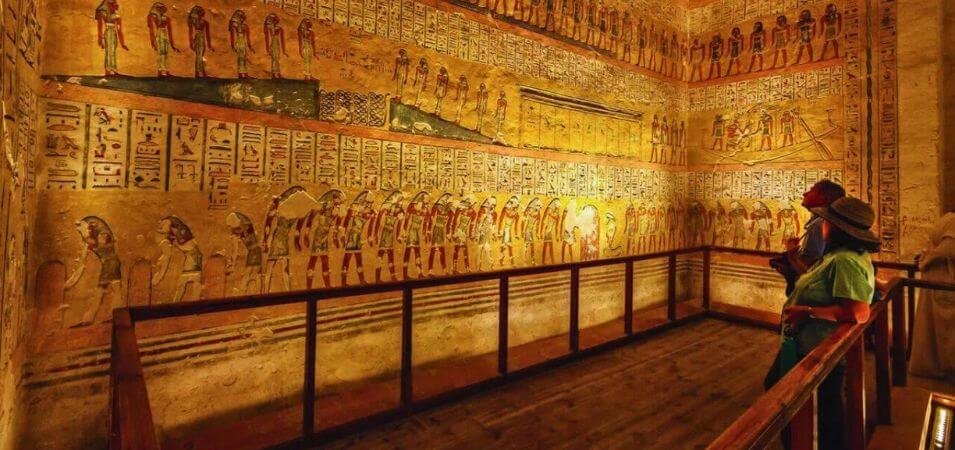
- The tombs’ walls are inscribed with sacred texts to guide the dead in the afterlife.
- Ramses II’s tomb (KV7) is massive but heavily damaged by floods.
- The “Curse of the Pharaohs” myth originated after Tutankhamun’s discovery.
- Tombs were often reused or expanded for new rulers.
- Medinet Habu Temple, nearby, served as Ramses III’s mortuary complex.
- Colossi of Memnon mark the ancient entrance to the Theban Necropolis.
- Modern conservation projects use 3D scans to preserve tomb art digitally.
The Valley of the Kings Facts – What Makes It Unique
Unlike other burial sites, the Valley of the Kings reflects both religious symbolism and architectural innovation. Its tombs were designed not to impress the living, but to serve the dead. The winding corridors, vivid wall paintings, and hidden chambers all mirror Egypt’s vision of the afterlife—a perilous journey toward rebirth.
The valley’s isolation beneath the Theban cliffs provided both protection and divine connection. The mountain’s pyramid-like peak, al-Qurn, symbolized the primeval mound of creation, making it a natural choice for eternal rest.
From Seti I’s intricate tomb art to the simplicity of later royal burials, each site tells a story of changing beliefs, evolving art styles, and the enduring desire for immortality.
Nearby Attractions Worth Exploring
A visit to the Valley of the Kings often includes other key sites that complete the ancient Theban experience:
- Temple of Hatshepsut (Deir el-Bahari): A stunning terraced temple dedicated to Egypt’s most powerful female pharaoh, blending seamlessly into the cliffs.
- Medinet Habu: The mortuary temple of Ramses III, decorated with scenes of battles and festivals.
- Colossi of Memnon: Two massive statues of Amenhotep III that once guarded a grand temple.
- Valley of the Queens: Resting place of royal wives and children, including the exquisite Tomb of Queen Nefertari.
- Luxor Temple and Karnak Temple: Located across the Nile, these monumental temples were once connected by the Avenue of Sphinxes, used for sacred processions.
Each of these sites offers a deeper understanding of how ancient Egyptians worshiped their gods, honored their rulers, and envisioned eternity.
Preserving the Valley of the Kings Today
Preservation is one of the valley’s greatest modern challenges. Years of exposure, humidity from visitors, and natural erosion threaten the fragile wall paintings. The Egyptian Ministry of Antiquities, in collaboration with UNESCO, works to conserve the tombs through advanced restoration techniques and controlled tourism.
Some tombs, such as those of Seti I and Nefertari, are now replicated in 3D virtual tours to minimize physical damage while keeping history accessible. Technology continues to uncover new data without disturbing the ancient landscape, proving that even after thousands of years, the valley still holds secrets waiting to be revealed.
Visiting the Valley of the Kings
Today, the Valley of the Kings is one of Egypt’s most visited attractions, offering a once-in-a-lifetime glimpse into the grandeur of the pharaohs. Visitors can enter several tombs daily, rotating to preserve their condition. Highlights include the tombs of Ramses IV, Ramses IX, and Tutankhamun, each showcasing vivid art and intricate carvings.
Guided tours from Luxor often include stops at nearby attractions like the Temple of Hatshepsut and Colossi of Memnon, creating a full-day experience through ancient history. The atmosphere is quiet yet overwhelming—standing inside a tomb, surrounded by hieroglyphs painted over 3,000 years ago, is a reminder of humanity’s endless fascination with eternity.
Conclusion – The Eternal Legacy of the Valley of the Kings
The Valley of the Kings remains one of Egypt’s most extraordinary legacies—a timeless archive of faith, power, and art. Beneath its sun-scorched cliffs lies the story of a civilization obsessed with eternity and the divine.
From the majestic tomb of Tutankhamun to the surrounding wonders of Deir el-Bahari and Medinet Habu, the valley continues to inspire awe. Each discovery adds a new chapter to Egypt’s ancient narrative, proving that history here is not merely studied—it is lived.
Even today, as archaeologists explore its hidden chambers, the Valley of the Kings stands as a bridge between past and present—a living monument to the eternal spirit of ancient Egypt.
Read more related articles:
