
The Dendera Temple is one of Egypt’s most extraordinary ancient landmarks, a place where history, spirituality, and architectural brilliance merge in a remarkably preserved complex. Nestled just north of Luxor along the west bank of the Nile, this temple dedicated to the goddess Hathor remains one of the best-preserved structures from ancient Egypt. From its decorated halls to the mysterious carvings hidden in its crypts, the Dendera Temple invites visitors into a world where mythology and daily life intertwine seamlessly.
This guide explores the temple’s history, architecture, interior design, purpose, and the many mysteries that make Dendera one of the most captivating temples in Egypt. You will also discover the attractions surrounding the site, helping you plan a rewarding cultural journey in the region.
The History of the Dendera Temple
The history of the Dendera Temple stretches across thousands of years. Although evidence shows that sacred structures existed on this site as early as the Old Kingdom around 4500 years ago, the surviving temple complex was primarily built during the Ptolemaic and Roman eras, between approximately 30 BCE and 14 CE. This makes Dendera one of the last major temples constructed in ancient Egypt, blending traditional Egyptian religious practices with Greco-Roman artistic influences.
Dendera was the principal cult center of Hathor, the goddess of joy, love, music, dance, fertility, and motherhood. She was beloved across Egypt, but Dendera was considered her sacred home. Ancient festivals honoring Hathor took place here, and priests carried out rituals designed to maintain universal harmony—a concept deeply embedded in Egyptian life.
What makes Dendera particularly fascinating is the degree to which it has remained intact. Its walls, ceilings, rooms, chapels, and underground crypts have been preserved so well that entering the temple feels like stepping back into ancient times. Unlike many temples damaged by erosion, flooding, or human interference, Dendera offers a nearly complete experience.
Architecture That Defines a Civilization
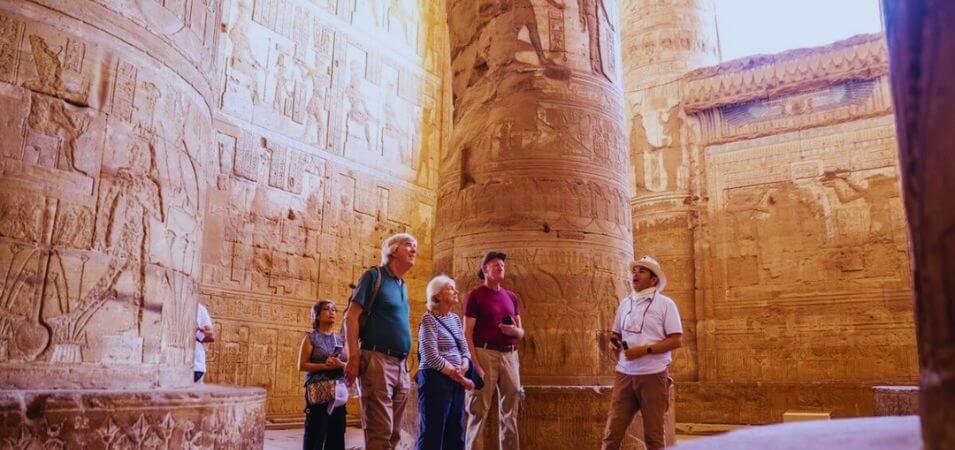
Walking into Dendera Temple is like entering a grand stone encyclopedia of Egyptian beliefs and artistic mastery. The architecture follows traditional temple design, yet its features are so well preserved that even small carved details remain clearly visible.
The Hypostyle Hall
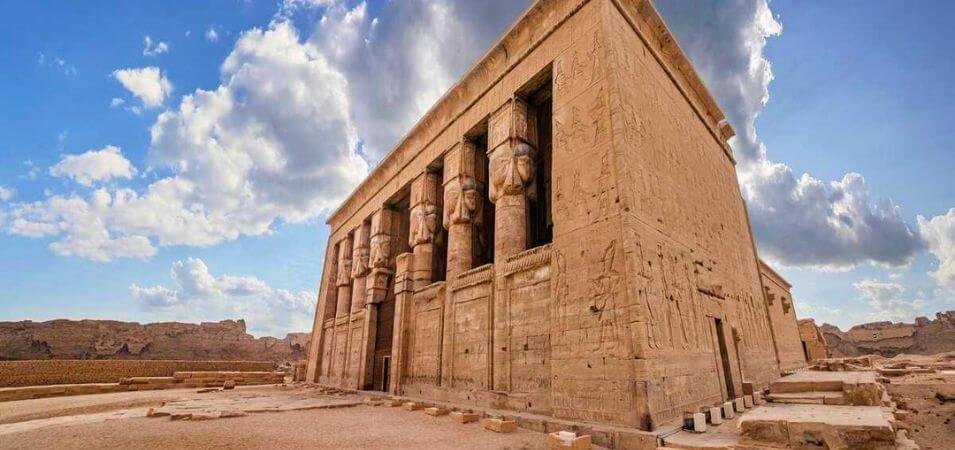
Your first encounter inside the temple is the majestic hypostyle hall, supported by 24 massive stone columns. Each column is crowned with a four-sided capital depicting the face of Hathor, smiling serenely as if welcoming visitors. These columns, towering and richly carved, immediately create an atmosphere of power and sacred importance.
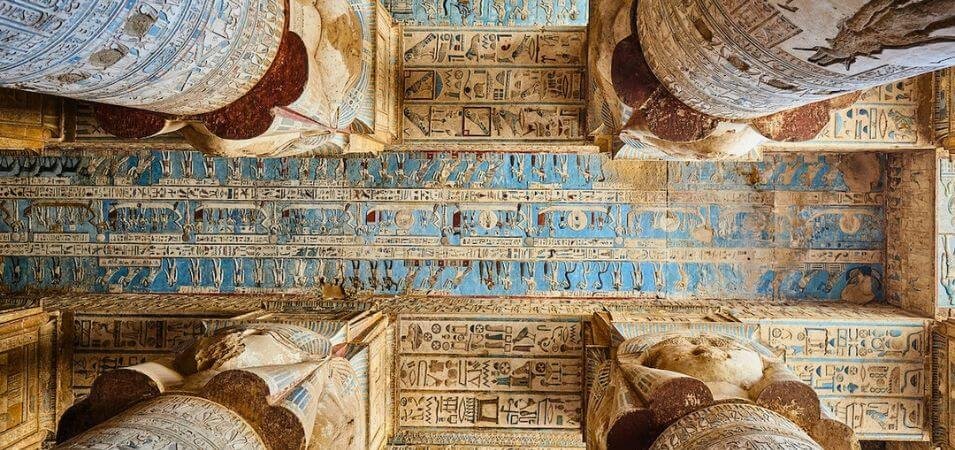
The ceiling is equally impressive. Once blackened by centuries of soot, it has now been cleaned, revealing vibrant blues and detailed scenes. The restored Zodiac of Dendera—an astronomical diagram originally removed and taken to the Louvre—remains one of the most iconic features associated with the temple.
Inner Chambers and the Sanctuary
Moving deeper into the temple brings you into a network of interconnected rooms, each with a sacred purpose. The sanctuary, located at the heart of the structure, once held the statue of Hathor. Only priests were allowed inside this most sacred room, where rituals took place daily to honor the goddess.
Surrounding chambers were used for preparing offerings, storing incense, holding ritual oils, and organizing ceremonial objects. These rooms also contain stunning carvings of pharaohs making offerings, musicians playing instruments, and Hathor receiving worship.
The Underground Crypts
Few temples in Egypt possess crypts as extensive as those at Dendera. Hidden beneath the floors, these dark, narrow passageways once stored valuable ritual items too sacred for public view. The walls of these crypts contain some of Dendera’s most mysterious carvings, including the controversial “Dendera Light”—a relief that has inspired endless debate and speculation.
The Rooftop Chapels
Ascending the temple’s staircase leads to rooftop chapels dedicated to Osiris. These chapels include unique carvings of the resurrection of Osiris and celestial imagery linking the god to astronomical cycles. The rooftop played a role in religious festivals; during certain celebrations, the statue of Hathor was brought up to bask in the sunlight, symbolizing renewal and divine energy.
The Purpose and Role of Dendera Temple
To understand the Dendera Temple, one must appreciate the role temples played in ancient Egypt. Unlike modern religious spaces where public worship takes place, temples in ancient Egypt served as the earthly residences of gods. The Dendera Temple functioned as Hathor’s home, and priests performed rituals daily to nourish her spirit and maintain the cosmic balance known as ma’at.
Festivals such as the Feast of the Beautiful Meeting—when Hathor’s statue traveled from Dendera to Edfu to reunite with the god Horus—were central to Egyptian spirituality. These journeys symbolized fertility, creation, and harmony. Dendera thus served as both a religious and cultural hub for ancient Egyptians.
The temple was also associated with healing. Hathor was believed to uplift the human spirit, bring joy, and protect mothers and children. Rituals involving music, incense, and soothing chants were practiced to restore emotional and spiritual well-being.
Mysteries of the Dendera Temple
Despite centuries of study, the Dendera Temple retains an aura of mystery. Scholars, visitors, and enthusiasts continue to explore its carvings, inscriptions, and symbolic meanings.
The “Dendera Light” Mystery
Deep within the crypts lies a relief that resembles a glass bulb containing a serpentine form attached to a lotus-shaped base. Some fringe interpretations claim this is evidence of ancient electricity or advanced technology. Egyptologists, however, interpret the image as a symbolic representation of creation—a serpent emerging from a lotus flower, symbolizing divine energy manifesting in the world.
Regardless of interpretation, the Dendera Light carving remains one of the most talked-about mysteries in Egyptian archaeology.
Astronomical Knowledge and the Zodiac
The Zodiac of Dendera is another source of fascination. Depicting the twelve zodiac signs and various constellations, it reflects the merging of Egyptian religion with Greek astronomical concepts during the Ptolemaic era. Some believe the zodiac hints at advanced ancient knowledge of the stars, while others view it as a symbolic map of the heavens used for religious rituals.
The Dendera Temple Stargate Theory
Among modern myths associated with the temple, the concept of a Dendera Temple Stargate is perhaps the most famous. Inspired by the temple’s astronomical carvings, precise architectural alignments, and unexplained symbols, some theorists suggest that Dendera may have served as a portal between dimensions or realms.
There is no archaeological evidence supporting an actual stargate. However, the ancient Egyptians did believe temples were bridges between the human and divine worlds. Rituals, chants, orientations, and symbolic carvings were designed to connect with celestial forces. This spiritual philosophy is likely what inspired the modern idea of the Dendera Temple Stargate.
For many visitors, the temple feels otherworldly—and perhaps that is part of its enduring appeal.
Attractions to Explore Around Dendera Temple
A visit to the Dendera Temple becomes even richer when you explore the surrounding area. Just a short distance away lies the vibrant city of Qena, known for its welcoming atmosphere and traditional culture. Travelers often enjoy visiting the Qena Souq, a lively local market where pottery, spices, rugs, and handcrafted souvenirs reflect the region’s artistic heritage.
The Nile Corniche in Qena provides a peaceful riverside experience. After exploring the temple’s chambers and carvings, many visitors enjoy relaxing by the Nile, watching boats drift by as the sun sets over the river.
An essential attraction near Dendera is the Abydos Temple, one of Egypt’s most sacred ancient sites. Dedicated to Osiris, the god of the afterlife, Abydos offers an incredible extension to your journey—its detailed carvings, sacred symbolism, and royal inscriptions create a powerful connection to ancient beliefs about life, death, and rebirth.
If your travels continue toward Luxor, you’ll find yourself surrounded by world-renowned sites such as the Temple of Karnak, Luxor Temple, and the Valley of the Kings. These landmarks, together with the Dendera Temple, create one of Egypt’s most fascinating cultural routes.
Inside the Temple: A Journey Through Time
Exploring the interior of Dendera Temple is a truly immersive experience. The play of light and shadow in the temple’s halls gives the carvings an almost living quality. Scenes of musicians, gods, pharaohs, offerings, and cosmic symbols blanket the walls. Many colors remain vivid, especially the blues and golds, offering a rare look at how brilliant Egyptian temples once appeared.
Every chamber seems to tell its own story. Some rooms are filled with depictions of ceremonial music; others show pharaohs interacting with Hathor. The rooftop chapels reveal mysteries of resurrection and cosmic cycles. The crypts plunge you into the unknown with carvings that spark imagination and debate.
The more time you spend inside the temple, the more you feel the intentions of its builders—the desire to connect the earthly world with the divine.
Why the Dendera Temple Continues to Captivate
The Dendera Temple is far more than an archaeological site. It is a preserved masterpiece of ancient thought, architecture, and spirituality. Its combination of beauty, mystery, and cultural depth creates an experience that resonates with visitors long after they leave.
From the enchanting face of Hathor carved into every column to the cosmic scenes on its ceilings, from the secrets buried in its crypts to the attractions surrounding it, Dendera offers a journey into one of the most intriguing chapters of ancient Egyptian civilization.
For anyone traveling through Egypt—or exploring its wonders from afar—the Dendera Temple stands as a timeless reminder of the brilliance, imagination, and spiritual depth of the ancient world.
