
The Hatshepsut Temple, formally known as the Mortuary Temple of Hatshepsut or Djeser-Djeseru (meaning “Holy of Holies”), is one of ancient Egypt’s most breathtaking and symbolic monuments. Nestled at Deir el‑Bahari on the west bank of the Nile near Luxor, its graceful terraces carved into sheer cliffs speak volumes—not only about royal ambition but also about architectural genius, religious devotion, and the extraordinary reign of Queen Hatshepsut. In this article, we’ll dive deep into when and why the temple was built, explore its design and interior, examine the life of Queen Hatshepsut herself, and unpack key facts and historical significance.
When Was Hatshepsut’s Temple Built?
Hatshepsut’s mortuary temple was constructed during Egypt’s Eighteenth Dynasty. According to historical records, construction began around her seventh regnal year and continued into her later years, possibly until her twentieth year on the throne. Some sources suggest the work started around 1479 BCE. The building process took approximately fifteen years, a major commitment in both labor and resources.
This long construction period also reflects how the design evolved. Originally inspired by the nearby temple of Mentuhotep II from the Middle Kingdom era, the architects made successive modifications to expand and refine the structure.
Why Was Hatshepsut’s Temple Built?
A Sacred and Political Monument
At its heart, the Temple of Hatshepsut functioned as a mortuary temple, a place of cult activity for the queen after her death. It was meant for her posthumous worship, and included shrines where rituals were performed both for her and for key gods, especially Amun.
But the temple was more than a funerary monument; it was political propaganda as well. Hatshepsut used it to solidify her legitimacy as a female ruler in a deeply patriarchal system. The inscriptions and reliefs inside repeatedly emphasize her divine birth, claiming Amun himself fathered her. This framed her not just as a queen, but as a pharaoh with a sacred mandate.
Economic and Diplomatic Messaging
One of the most famous scenes in the temple commemorates Hatshepsut’s expedition to Punt, a verdant and wealthy land. These reliefs depict exotic goods—incense, ebony, animals—brought back to Egypt, underlining her economic wisdom and successful foreign trade.
Through such imagery, Hatshepsut tied her reign to prosperity and international reach, making the temple both a religious center and a symbol of her political and economic achievements.
Religious Symbolism and Festival Role
Religiously, the temple aligned with major Egyptian rituals. One of its axes was used during the Beautiful Festival of the Valley, in which the barque (sacred boat) of Amun traveled across the Nile to visit mortuary temples on the west bank. The temple’s central east–west axis received Amun’s barque, while a north–south axis symbolized the pharaoh’s life cycle—from coronation to rebirth.
About Queen Hatshepsut
To understand the temple is to understand Hatshepsut, one of ancient Egypt’s most remarkable rulers. Born around 1507 BCE, she was the daughter of Thutmose I. When her husband and half-brother Thutmose II died, she acted as regent for her stepson, Thutmose III. But unlike many regents, she went further—declaring herself pharaoh.
As a female pharaoh, she broke tradition: she often portrayed herself in masculine royal regalia (including the false beard), asserting her authority in visual and textual forms. Her reign, estimated from 1479 to about 1458 BCE, was marked by building projects, diplomatic missions (like Punt), and religious consolidation.
Her chief architect and close confidante was Senenmut, who oversaw many of her building initiatives—including the temple. Some scholars even suggest their relationship went beyond professional: there are hints in posture and proximity in tombs that suggest deep personal trust.
After her death, however, her legacy was partially erased. Thutmose III, her stepson and successor, defaced and removed many of her images, and later kings omitted her from king lists. Yet, her temple survived more intact than many monuments, giving us a rich window into her reign.
Architecture of the Hatshepsut Temple
Terraced Elegance
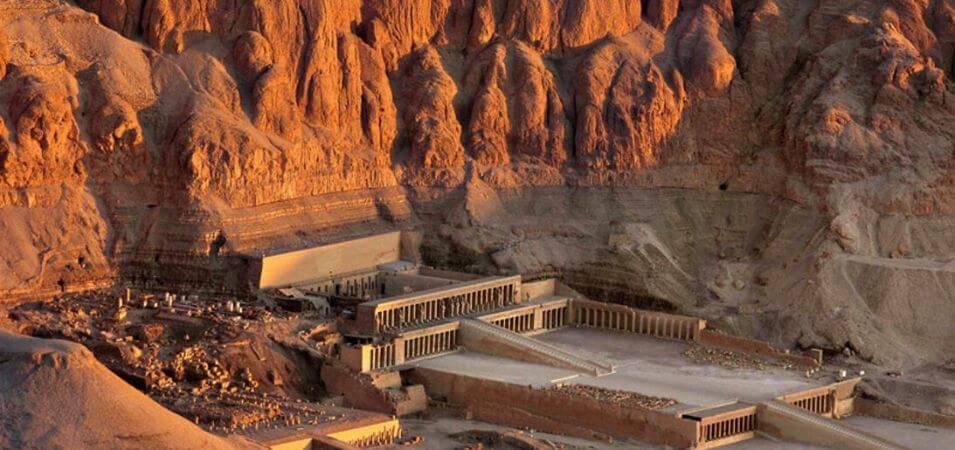
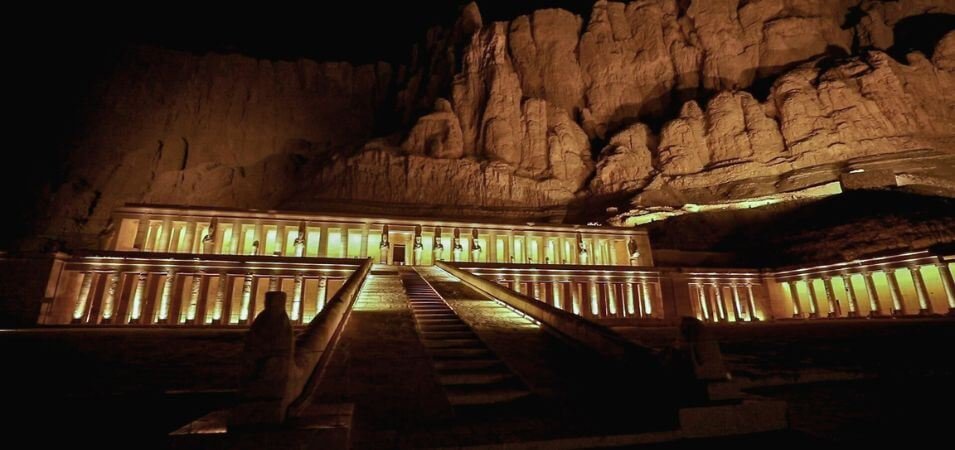
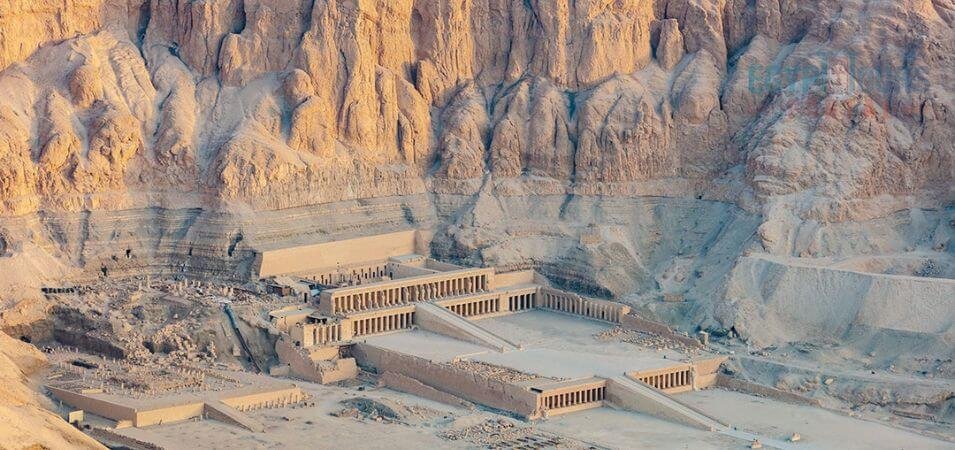
The temple is carved into the cliffs at Deir el-Bahari, forming a dramatic triangular façade that seems to rise organically from the rock. This terraced design consists of three levels, connected by long ramps, giving it a layered, vertical form that immediately captures the attention of visitors exploring the nearby Valley of the Kings and other major Luxor attractions.
Each terrace is fronted by colonnaded porticoes—rows of columns that frame open courtyards. The symmetry and harmony of the layout reflect the Egyptian principle of ma’at, or cosmic balance, making the building not just visually stunning but deeply symbolic. Its striking presence also complements nearby attractions such as the Temple of Karnak and the Luxor Temple, reinforcing its role as one of the most captivating sites on any Luxor itinerary.
Integration with Nature
One of the most striking aspects of the temple is how it blends seamlessly with its surroundings. The high cliffs behind it form a natural amphitheater, and the architecture respects this shape rather than fighting it. Originally, terraces were planted with gardens and exotic trees brought from Punt, and pools reflected the sky and rock. Although the gardens are gone now, ancient reliefs show how lush and carefully cultivated those spaces once were.
Material and Engineering
Constructed from limestone and sandstone, the temple required careful quarrying and transport from nearby cliffs. Ancient builders used ramps and precise surveying to lift and align massive stones. These techniques allowed them to carve deep, crisp reliefs that survive to this day.
Interior and Decoration
Walking through Hatshepsut’s temple, one is immersed in a narrative carved in stone. The walls of the porticoes and halls are filled with reliefs that tell her story: from her divine conception to her reign and wealth-building expedition to Punt.
Divine Birth Reliefs
In the sanctuary and on the terraces, you’ll find depictions of the divine birth of Hatshepsut. In these scenes, the god Amun is shown as her father, legitimizing her rule through divine lineage. These carvings served a dual purpose: religious devotion and political propaganda, reinforcing her right to be pharaoh.
Expedition to Punt
Perhaps the most evocative reliefs are those documenting Hatshepsut’s expedition to Punt. These panels feature exotic flora, incense trees, and animals, showing what her trade mission brought back. The expedition was a major achievement of her reign: not only did it bring wealth, but it highlighted her leadership and the kingdom’s diplomatic reach.
Chapels and Sanctuaries
The temple also contains chapels dedicated to other deities. On one terrace, there are shrines to Hathor (the cow goddess), and on another to Anubis, the god of mummification and the afterlife. The sanctuary of Amun is built directly into the cliff, showing reverence for that god, whom Hatshepsut claimed as her divine patron.
There was also a solar chapel with an open altar aligned with the sun, emphasizing the connection between the pharaoh, the sun god, and rebirth.
Historical Significance and Legacy
The Hatshepsut Temple is not just an architectural masterpiece. It has a layered legacy:
- Political Message: Through its reliefs, layout, and grandeur, the temple communicates Hatshepsut’s power and legitimacy. Her reign was unprecedented for a female ruler, and the temple helped cement her historical place.
- Religious Center: The temple served as a cult place for Hatshepsut after death, but also participated in wider religious practices, such as the Beautiful Festival of the Valley when Amun’s barque visited mortuary temples.
Architectural Influence: Its terraced design and integration with the cliff, inspired by the temple of Mentuhotep II, while surpassing it in scale, represent a high point of New Kingdom innovation. - Erasure and Rediscovery: Following Hatshepsut’s death, her stepson Thutmose III defaced many of her images and inscriptions. Yet, because the temple was well built and monumental, much of it survived. It was rediscovered in the 19th century and remains one of the best-preserved royal temples in Egypt.
- Modern Archaeological Importance: Recent excavations continue to shed new light on the site. For instance, archaeologists have uncovered foundation blocks and decorated stone fragments, giving fresh insight into its original color and the name of the architect, Senenmut. Such work reconnects us with Hatshepsut’s vision and the artisans who helped build it.
Interesting Facts About the Hatshepsut Temple
- The temple’s ancient name, Djeser-Djeseru, translates to “Holy of Holies,” emphasizing its sacred nature.
- The structure reaches about 30 meters (roughly 97 feet) in height as its terraces ascend the cliff.
- The original pathway to the temple included an avenue of sphinxes and obelisks, though many of these have been lost or destroyed over time.
- The reliefs inside are remarkably detailed, narrating diplomatic missions, divine intervention, and the day-to-day rituals that affirmed Hatshepsut’s power.
- The temple has two main structural axes: one east–west (for festival rituals) and one north–south (symbolizing the pharaoh’s life and rebirth).
Challenges and Preservation
Over centuries, the temple suffered from deliberate damage. Thutmose III, perhaps motivated by resentment or political erasure, ordered the defacement of many of Hatshepsut’s images. Despite this, the core structure held up remarkably well.
Modern archaeology has played a major role in its preservation. Restoration efforts over time have cleaned and stabilized the terraces, and new excavations (including ones led by prominent archaeologists) are uncovering previously buried or forgotten elements. Recent work even revealed new decorated blocks from the valley temple’s foundation wall, shedding light on its original color and design
Why the Hatshepsut Temple Matters Today
The Temple of Hatshepsut remains a symbol of both artistic innovation and female power in ancient Egypt. As one of the few pharaohs who was a woman but ruled as king, Hatshepsut used architecture not only to honor the gods but also to assert her rightful place in the pharaonic lineage. Her temple stands as a testament to her legacy, bridging spiritual devotion, political legitimacy, and aesthetic mastery.
For modern visitors and scholars alike, the temple offers a rich narrative: you can walk its terraces, imagine those once-lush gardens, and reflect on how an audacious queen carved her story into stone. Its preservation reminds us of how architecture can immortalize ambition, faith, and identity across millennia.
Conclusion
In exploring the Hatshepsut Temple, we see more than a ruin: we see a carefully crafted story about rule, lineage, and divine favor. Built in the 15th century BCE, the temple was both a religious sanctuary and a political statement, embodying Queen Hatshepsut’s power, piety, and vision. Through its terraces, ramps, colonnades, and richly carved reliefs, the temple continues to speak to us across time. It endures as one of Egypt’s architectural masterpieces—and as a bold monument to one of its most remarkable rulers.
