
The Philae Temple is one of Egypt’s most enchanting ancient sites, a place where history, mythology, and architectural brilliance come together in a setting that feels almost otherworldly. Surrounded by the shimmering waters of the Nile and framed by rocky landscapes, the temple has fascinated travelers for centuries. Its story is not only about the gods the Egyptians worshipped, but also about the remarkable modern efforts taken to preserve it. Understanding the history of Philae Temple —its architecture, purpose, relocation, and interior — adds deeper meaning to any visit—and reveals why it remains one of the most beloved temples in Egypt.
The History of Philae Temple
The history of Philae Temple is rooted in the worship of Isis, one of the most important deities in ancient Egyptian religion. For centuries, the island of Philae served as a spiritual center dedicated to Isis, known as the mother of Horus and a symbol of magic, protection, and motherhood. Ancient Egyptians believed this sacred island was one of the places where Isis mourned Osiris after his death, giving the site emotional and spiritual importance. Today, its location near other major Aswan attractions—such as the Unfinished Obelisk, the Aswan High Dam, and the Nubian Museum—makes the area even more appealing for visitors interested in Egypt’s heritage.
Construction on the temple complex began during the reign of Ptolemy II in the 3rd century BC, although several rulers expanded it over time. Because of this long period of development, the temple beautifully blends elements of ancient Egyptian religious architecture with Greek and Roman artistic influence. The result is a unique fusion that makes the Philae Temple stand out from other monuments of its era, especially when paired with nearby sites like the Temple of Kalabsha and the atmospheric Nubian villages along the Nile.
During the Roman period, the temple continued to function as a place of worship. Even after Christianity spread through Egypt, parts of the temple were repurposed for Christian use. Crosses and altars were added, and some reliefs were carefully altered to reflect the new religious beliefs. This mix of sacred traditions gives the temple a layered and complex history, complementing the cultural diversity found throughout Aswan’s historic landscape.
When was the Temple built?
Although smaller shrines existed earlier, the main Philae Temple—dedicated to the goddess Isis—began construction around 280 BC under the rule of Ptolemy II. Over the next several centuries, additional buildings were added, including the Temple of Hathor, the Kiosk of Trajan, and various ceremonial gateways. Each addition contributed to the island’s sacred atmosphere, creating a complex that served religious, political, and cultural purposes throughout antiquity.
The extended construction timeline means that Philae Temple is not the work of a single era or ruler. Instead, it represents centuries of devotion, evolving artistic styles, and the changing religious landscape of Egypt under Greek and Roman influence.
Discover the Location of the Temple
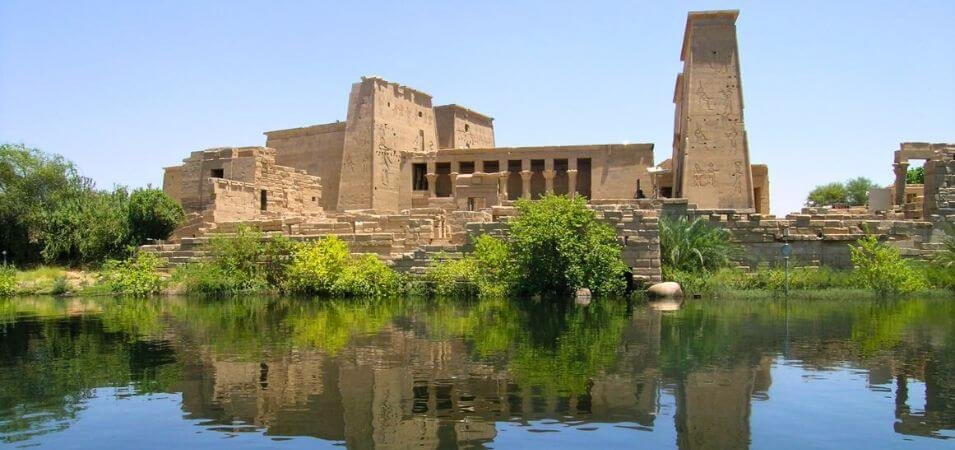
Today, the Philae Temple is located on Agilkia Island near Aswan in southern Egypt. However, this was not its original location. The temple originally stood on Philae Island, a small and picturesque island south of Aswan. The site was once described as one of the most beautiful spots in Egypt, surrounded by clear Nile waters and rugged granite formations.
Unfortunately, when the Aswan Low Dam was completed in 1902, Philae Island began to flood for part of the year. The temples were submerged for months at a time, causing severe damage. After the construction of the Aswan High Dam in the 1960s, the situation became critical: without intervention, the temples would have disappeared underwater forever.
When Was Philae Temple Moved?
The rescue of Philae Temple is considered one of the greatest archaeological preservation efforts ever undertaken. Between 1972 and 1980, the entire temple complex was dismantled, relocated, and rebuilt block by block on nearby Agilkia Island. The project was led by UNESCO as part of its campaign to protect the Nubian monuments threatened by the rising waters of the High Dam.
This monumental effort involved cutting the temple into more than 40,000 pieces, transporting them across the river, and reconstructing everything with precise alignment. Engineers even shaped Agilkia Island to resemble the original island’s landscape, ensuring the temple’s new home preserved its original charm and atmosphere.
Today, travelers who visit the site are seeing not only ancient history but also a modern engineering marvel. Without the relocation project, the Philae Temple would have been lost beneath the waters of Lake Nasser.

Architectural Beauty of Philae Temple
The architecture of the Philae Temple is a perfect example of Egyptian design blended with Ptolemaic and Roman artistic influence. Its entrance features a grand pylon decorated with scenes of pharaohs making offerings to Isis, Horus, and other gods. These carvings remain sharp and expressive despite the centuries they’ve endured.
As visitors pass through the pylons, they enter an open courtyard surrounded by colonnades, each column topped with beautifully carved capitals representing floral and geometric patterns. These columns demonstrate the skill and creativity of the craftsmen who built them.
The walls of the temple are decorated with reliefs depicting mythological stories, royal rituals, and ceremonial scenes. Many of these scenes were meant to honor Isis and reflect her role in the Osiris myth. The details show everything from magical rituals to boats used in sacred processions.
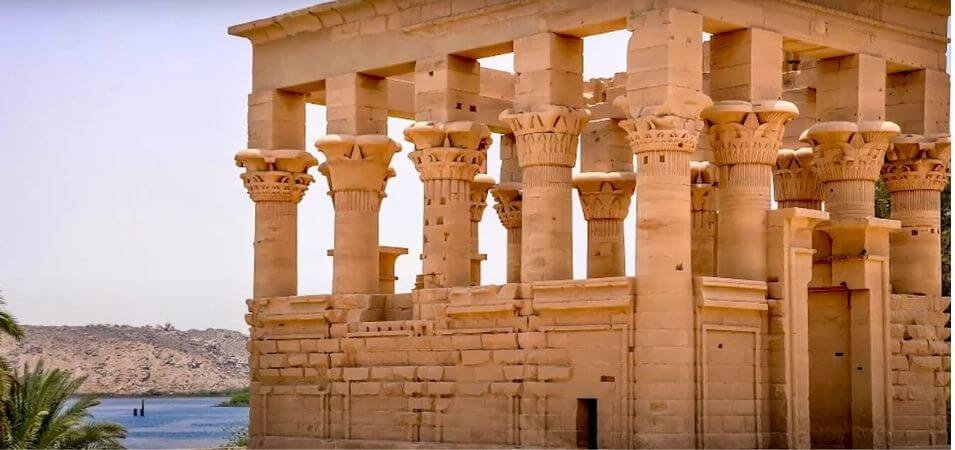
Nearby stands the Kiosk of Trajan, often referred to as “Pharaoh’s Bed” because of its elegant, airy design. Although unfinished, it is one of the most photographed structures in the complex thanks to its tall, graceful columns and beautiful views over the Nile.
The Interior of Philae Temple
Inside the temple, the atmosphere becomes quiet and mysterious. The inner chambers are dimly lit, creating a sense of reverence. The sanctuary of Isis—the holiest part of the temple—once held the sacred barque that carried the goddess during festivals. While the barque is no longer present, the stone base and decorative reliefs surrounding it give a sense of the rituals that once took place here.
Smaller rooms around the sanctuary display scenes of priests performing offerings and magical ceremonies. The hieroglyphics are so detailed that even today, experts study them to understand ancient religious practices. Some walls still show traces of the original paint, adding a vivid layer to the temple’s artistic legacy.
Christian-era alterations can also be seen inside the temple. Some pagan reliefs were carved away or covered by crosses. Instead of destroying the building, early Christians adapted it for their own religious practices, allowing the temple to remain intact and useful long after the ancient Egyptian religion faded.
The Purpose of Philae Temple
The primary purpose of Philae Temple was to honor the goddess Isis, but its significance extended far beyond simple worship. It was a pilgrimage destination for devotees from across Egypt and Nubia. The temple served as a center for healing rituals, magical ceremonies, and royal offerings. Festivals dedicated to Isis filled the island with music, processions, and sacred reenactments of mythological events.
Because of its location near the southern border of ancient Egypt, the temple also played a political role. It helped reinforce Egyptian identity and religion in the region, acting as a symbolic guardian of the borders. As different rulers took control of Egypt, the temple continued to serve as a statement of continuity and tradition.
Interesting Facts About Philae Temple
The Philae Temple holds many fascinating stories. It was one of the last places in Egypt where the ancient religion was practiced. In fact, inscriptions from the temple indicate that pagan worship continued here until at least the 6th century AD, long after most of Egypt had converted to Christianity.
Another remarkable fact is that despite spending decades partially submerged before its relocation, the temple’s reliefs survived surprisingly well. Sunlight underwater was filtered naturally, protecting the carvings from fading. Still, the relocation ensured the structure would not be destroyed beyond repair.
The island setting also adds to the temple’s magic. Approaching by boat creates a dramatic first impression. The temple appears slowly as you glide across the water, rising above the island like a timeless guardian of the Nile.
Visiting Philae Temple Today
A visit to Philae Temple offers a peaceful yet awe-inspiring experience. The temple is often quieter than some of Egypt’s larger sites, giving visitors time to appreciate its intricate carvings, walk through its courtyards, and imagine the ceremonies that once took place there.
Many travelers prefer visiting in the late afternoon, when the light softens, and the island takes on a golden glow. Others come for the Sound and Light Show in the evening, where the temple is illuminated as stories of Isis and Osiris are narrated.
No matter when you visit, the combination of natural beauty and ancient architecture makes Philae Temple one of the highlights of Aswan.
Conclusion
The Philae Temple is more than an archaeological site—it’s a symbol of ancient devotion, artistic genius, and modern preservation. From its origins on Philae Island to its relocation to Agilkia, the temple has survived against all odds. Its history, architecture, interior, and sacred purpose all contribute to its lasting fascination. For travelers seeking an authentic glimpse into Egypt’s spiritual and architectural heritage, the Philae Temple is an unforgettable experience.
