Picture this: you are standing in near-total darkness, deep inside a mountain, surrounded by hundreds of strangers who have all stopped talking at the same moment. Then a single blade of gold slides through the temple doorway, races along the hall, and ignites the face of a pharaoh who has waited in the dark for more than 3,200 years. That is the Abu Simbel Sun Festival, and it lasts only about twenty minutes, twice a year.
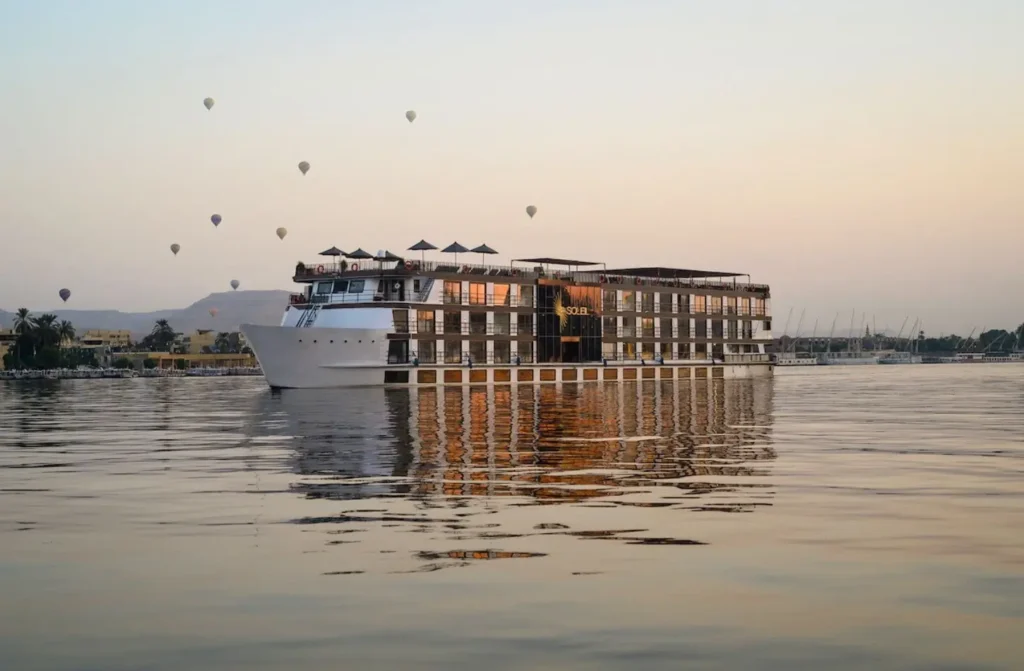
If you have ever wanted to stand in that crowd, this guide shows you exactly how, from the science of the alignment to the best way to reach the temple. Many travelers who plan it well choose one of our Lake Nasser cruises, so the temple is only a short sail or drive away when the sun finally rises.
What Is the Abu Simbel Sun Festival?
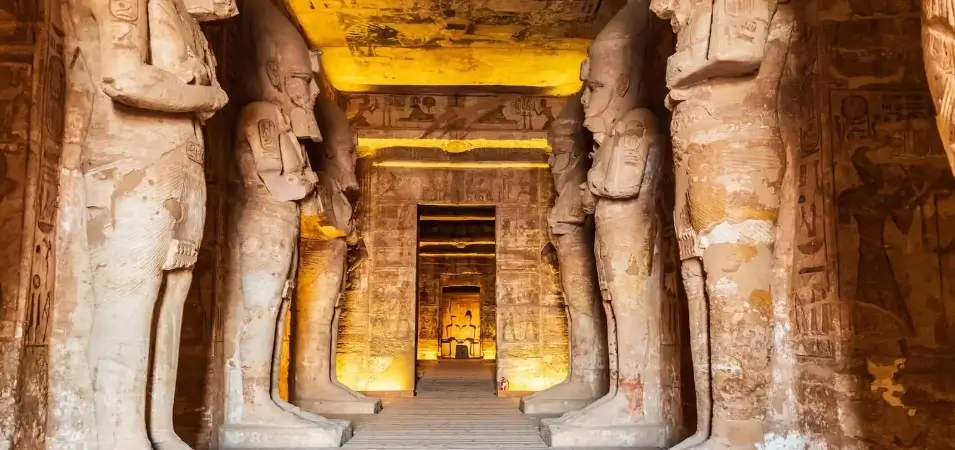
The Abu Simbel Sun Festival is a biannual celebration of a solar alignment built into the Great Temple of Ramesses II in southern Egypt. On two mornings each year, sunlight enters through the temple’s eastern doorway, crosses the pillared hall, and reaches the innermost chamber, known as the sanctuary. There it illuminates three of the four statues seated against the back wall: Ramesses II himself and the gods Amun-Ra and Ra-Horakhty. The fourth figure, Ptah, a god linked with darkness and the underworld, stays in shadow, exactly as the ancient designers intended.
Nobody needs a ticket to a stage show to feel why this matters. The whole spectacle is created by stone, geometry and sunlight, with no mechanism at all. The temple was carved into a sandstone cliff more than three thousand years ago, and the architects aimed its axis so precisely that light reaches a room more than sixty meters inside the rock.
Over the years the Abu Simbel Sun Festival has grown from a quiet sunrise watched by a handful of people into a proper event. Local authorities decorate the town, folklore troupes perform songs and dances in traditional dress on the night before, and in 2025 the celebrations stretched over several days. Visitors from Egypt and abroad now travel for one reason: to be inside the temple at the exact moment the light arrives.
The Temples Behind the Light
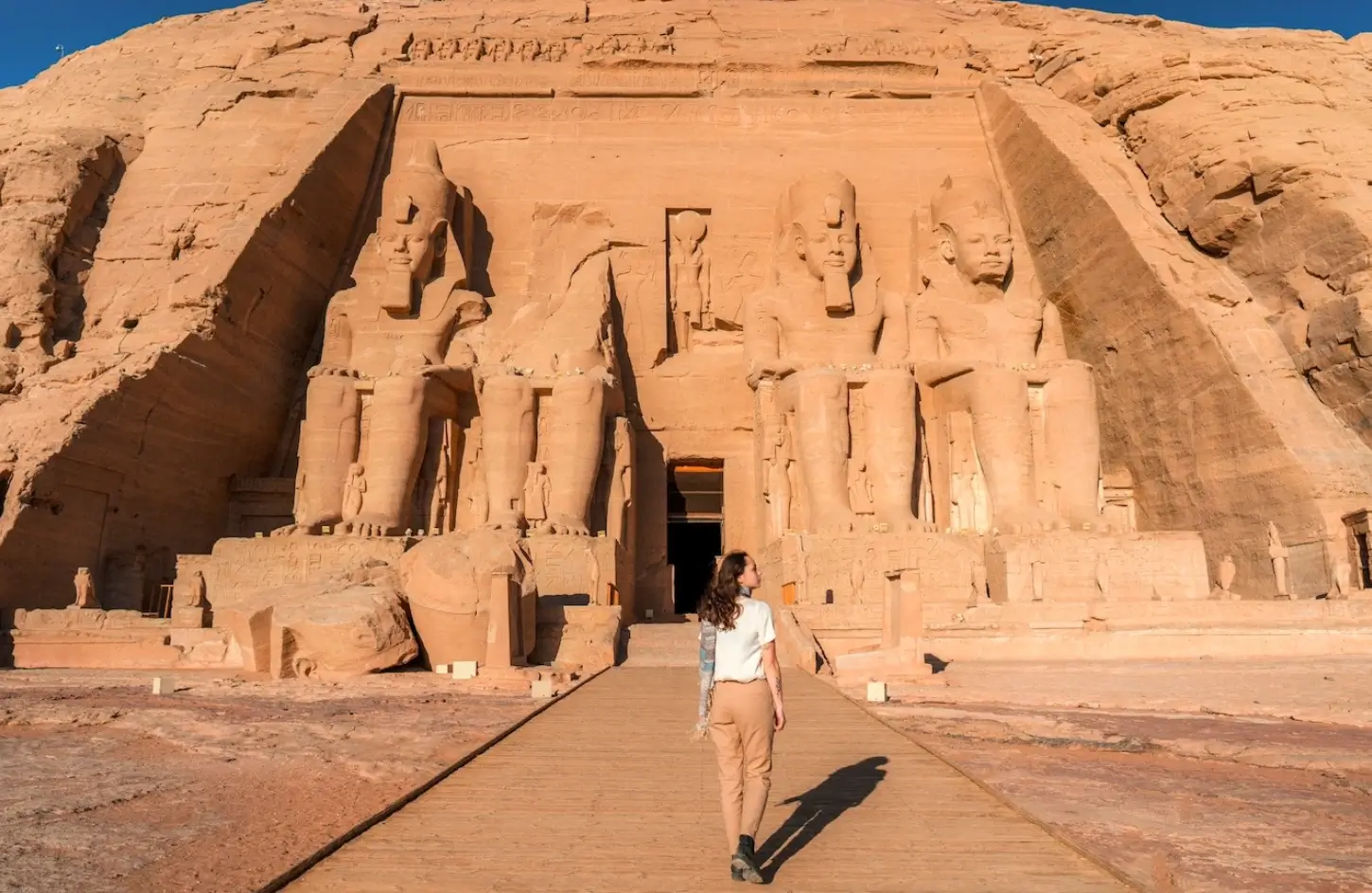
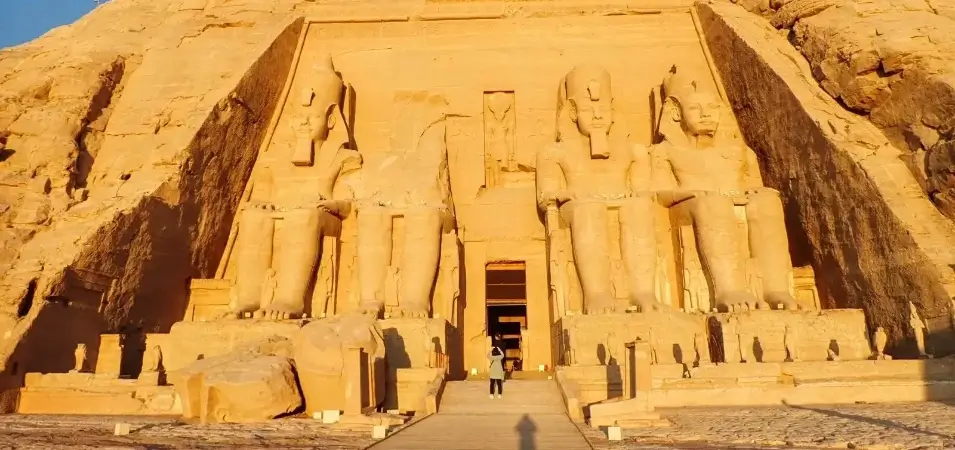
To understand the Abu Simbel Sun Festival, it helps to know what you are looking at. Ramesses II, the 19th Dynasty pharaoh often called Ramesses the Great, ordered two rock-cut temples to be built at the southern edge of his kingdom during the 13th century BCE. The Great Temple is dedicated to Amun-Ra, Ra-Horakhty and Ptah, and to the king himself, who is presented as a living god. Its façade is guarded by four colossal seated statues of Ramesses, each about 20 meters tall, and the whole front rises roughly 30 meters above visitors’ heads.
Beside it stands the smaller temple, dedicated to the goddess Hathor and to Queen Nefertari, his most beloved wife. Having a temple built for a queen on this scale was extremely rare, and it still says a great deal about how Ramesses wanted to be remembered. Together, the two monuments were designed to impress travelers coming north from Nubia with the power of Egypt, and they still do.
Inside the Great Temple, a long axis leads from the entrance through two halls to the sanctuary. The alignment of this axis is the reason people gather in the dark every February and October. Carvings along the walls show the king’s triumph at the Battle of Kadesh, so the walk inward is also a tour of royal propaganda.
Why Do the Festival Dates Fall on 22 February and 22 October?
The two dates are traditionally linked to Ramesses II himself. A popular explanation says that 22 October marks his birthday and 22 February the anniversary of his coronation. It is a lovely story, and many guides repeat it, but it is important to be honest: no ancient text confirms it. Some scholars suggest the dates may instead relate to turning points in the agricultural year, and the truth is probably lost with the architects.
There is one more detail that surprises most visitors. In the time of Ramesses, the light arrived a day earlier, on 21 February and 21 October. After the temples were moved in the twentieth century, the event shifted by a single day, which is why today’s Abu Simbel Sun Festival is celebrated on the 22nd.
How the Relocation Changed Everything
The shift is part of one of the most dramatic rescue stories in archaeology. When the Aswan High Dam was built in the 1960s, the rising waters of Lake Nasser threatened to swallow Abu Simbel forever. An international campaign led by UNESCO saved the temples by cutting them into more than a thousand huge blocks and rebuilding them on an artificial hill about 65 meters higher and some 200 meters back from the original site. The relocated complex was inaugurated on 22 September 1968.
Engineers worked hard to recreate the original orientation, and the result is astonishing: the rebuilt temple is off by just one day. Stand in front of the façade and remember that every stone you see was once cut out and moved.
Abu Simbel Sun Festival Dates and Times for 2026 and 2027
Here is the schedule you need, with the practical details that matter on the day:
- Autumn 2026: Thursday, 22 October. Local clocks are still on daylight saving time, so sunrise is later than many people expect.
- Winter 2027: Monday, 22 February. Expect an earlier start, usually around 6:20 AM.
- Timing of the light: In 2025 the illumination of Ramesses II’s statue began at 6:54 AM and ended at 7:16 AM, a window of 22 minutes. Expect something similar in 2026.
- Strongest moment: The sanctuary is brightest for roughly the first ten to fifteen minutes, then the beam slides across the statues and fades.
- Nearby days: The sun also enters the sanctuary on the days just before and after the 22nd, so the effect is visible on 20, 21, 23 and 24 October, usually with far smaller crowds.
Because official times can shift by a few minutes and clocks change with the season, always confirm the exact start time with your guide on the day before you travel. The Abu Simbel Sun Festival is a natural event, so cloudy mornings are possible, although Aswan’s desert skies are clear most of the year.
What Happens on Festival Morning, Hour by Hour
A typical festival morning follows a rhythm that is worth knowing in advance, because the schedule is tight and the queues start early.
Around 3:00 to 4:00 AM: Road convoys leave Aswan for Abu Simbel. If you are staying in town or on a boat moored at the site, you can sleep a little later.
Around 4:30 to 5:00 AM: Visitors arrive at the temple area. Security checks begin, and queues form at the entrance. Arriving early is the single most useful thing you can do.
5:30 AM: The courtyard in front of the façade fills up. The sky starts to lighten and the four giant statues of Ramesses emerge from the dark, which is a memorable sight on its own.
Sunrise: Visitors are admitted in groups. Inside, the hall is hushed. The first ray touches the sanctuary and the three statues begin to glow, one by one.
After the light: Once the beam fades, the mood turns joyful. People gather outside to eat, drink, take photographs and watch performances, and the whole Abu Simbel Sun Festival turns into a street party in the desert.
Remember that crowd control is strict. Visitors are usually moved through the sanctuary in a continuous flow, so you may have only a short time in front of the illuminated statues.
How to Get to Abu Simbel for the Festival
Abu Simbel sits near the Sudanese border, around 280 kilometers south of Aswan, so getting there takes planning. You have four realistic options.
By road from Aswan. The drive takes about three hours each way along a desert highway. Most tours leave in the middle of the night to reach the temple before dawn. It is the cheapest option, but also the most tiring.
By air. A short flight from Aswan takes about 45 minutes, and from Cairo you usually connect through Aswan. Flights can be limited and sell out around the festival, so book early and check current schedules, because services have occasionally been suspended for weather.
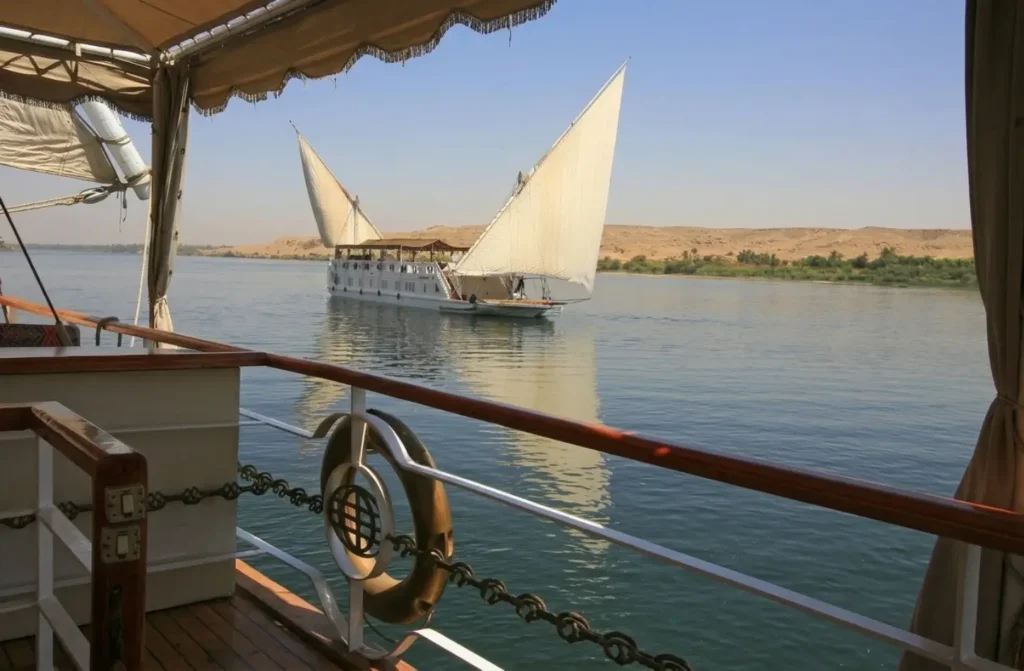
By Lake Nasser cruise. This is the most relaxed way to approach the temple. A multi-night sailing between Aswan and Abu Simbel visits the Nubian temples along the shore, and the ship becomes your hotel and transport in one. Itineraries operate from October to April, which happily covers both festival dates.
By private tour. If you are short on time, a private driver and Egyptologist guide can organize the logistics so you only worry about the sunrise. We can arrange this as part of a tailor-made Nile cruise with all transfers included.
Day Trip, Overnight Stay or Lake Nasser Cruise?
Choosing how to experience the Abu Simbel Sun Festival depends on your energy, budget and how much of southern Egypt you want to see.
A day trip is the cheapest and most flexible. You leave Aswan around 3:00 AM, watch the sun, explore the temples, and return by early afternoon. It is a long day, but it works well for travelers who already have Aswan on their itinerary.
An overnight stay in Abu Simbel town lets you sleep closer to the temple and avoid the nocturnal drive. Rooms are limited, though, and prices rise sharply around the festival, so you must reserve far ahead.
A Lake Nasser cruise is the most atmospheric option. You travel across a vast, quiet lake, stop at temples such as Kalabsha, Wadi El Seboua and Amada, and finish at Abu Simbel. Because cruise itineraries run on set days, the key is choosing a departure that places you at the temple on the festival morning, and our team can check that with you before you pay anything.
For travelers combining the festival with a classic river journey, many pair it with a Nile cruise from Luxor to Aswan, which covers Karnak, Edfu and Kom Ombo before you head south.
Tickets, Costs and Crowds
For the festival days, entry prices have been reported at about 1,200 EGP for adults and 600 EGP for students, which is higher than the regular rate. Prices and rules change, so treat these numbers as a guide and ask us to confirm before you book.
Your biggest costs will be transport and accommodation rather than the ticket. A private guide, a driver, a flight or a cruise cabin will make up most of your budget, and everything becomes more expensive near the festival. To get a realistic picture, read our guide to Nile cruise cost in 2026, which explains how prices vary by ship type and season.
As for crowds, the Abu Simbel Sun Festival is the busiest day of the year at the temple. Expect long queues, limited time inside the sanctuary and a lively, slightly chaotic atmosphere. If you dislike crowds, consider visiting on 21 or 23 October, when the sun still reaches the sanctuary and the courtyard is much calmer.
Photography and Viewing Tips
The sanctuary is small, the light is dramatic and the time is short, so a little preparation goes a long way.
- Stay calm and present. Take one or two photographs, then put the camera down and watch the light with your own eyes.
- Check the rules. Photography regulations inside the temple can change, and flash is never welcome. Ask your guide before you enter.
- Shoot the façade at dawn. The best pictures often come outside, when the rising sun turns the four colossal statues orange.
What to Wear and Pack
For the Abu Simbel Sun Festival, October mornings are mild, while February can feel surprisingly cold before sunrise. Layers are the answer. Bring a light jacket you can remove once the sun climbs, and wear comfortable closed shoes, because the courtyard is gravelly and the queue is long.
Pack sunglasses, a hat, sunscreen and a refillable water bottle, as the sun becomes strong quickly after the show. Carry your passport and any required permits, since checkpoints are common on desert roads.
Combine the Festival with a Nile Cruise
The Abu Simbel Sun Festival is spectacular on its own, but it becomes unforgettable as the final chapter of a longer journey. Southern Egypt packs an extraordinary amount of history into a small area, and the river is the most comfortable way to see it.
A well-planned trip might look like this:
- Days 1 to 2, Luxor: Visit Karnak, Luxor Temple and the Valley of the Kings. Our guide to Luxor attractions lists the best stops.
- Days 3 to 5, Nile cruise: Sail through Esna, Edfu and Kom Ombo while your floating hotel moves with you.
- Day 6, Aswan: Explore Philae Temple, the High Dam and a Nubian village. Our overview of Aswan attractions will help you choose.
- Day 7, Abu Simbel: Travel south before dawn to witness the Abu Simbel Sun Festival, then return in the afternoon.
If you prefer a longer, slower rhythm, a Nile cruise and stay package adds nights in a hotel before or after the sailing. Travelers who value privacy often choose a luxury Nile cruise, with spacious suites and attentive service, as a restful base after the early start at the temple.
Ships and dates fill quickly, especially in autumn. If you want a proven favorite, browse our best-selling Nile cruises and let us fit the festival around the sailing.
Is the Abu Simbel Sun Festival Worth It?
Honestly, it depends on what you want. If you are hoping for a long, quiet moment alone with the statues, the festival morning may feel rushed, because the crowds are big and the time inside is short. But if you want the thrill of a shared moment, the sense that thousands of people from every country have woken up in the dark for the same reason, there is nothing quite like it.
Many experienced travelers find a good compromise: they visit the temple on the festival day for the atmosphere, then return another day, or arrive a day early, to explore the interior in peace. Either way, Abu Simbel itself is worth the journey. The Abu Simbel Sun Festival simply adds a layer of ancient astronomy to an already extraordinary place.
As for safety, Egypt’s southern tourist routes are well organized, and convoys and checkpoints are part of normal travel. If you have questions, our guide on whether it is safe to go on a Nile cruise explains how travel in Egypt works for visitors today.
Frequently Asked Questions About the Abu Simbel Sun Festival
When is the Abu Simbel Sun Festival?
It takes place twice a year, on 22 February and 22 October. In 2026 the autumn date is Thursday, 22 October, and the next one is Monday, 22 February 2027.
What time does the sun reach the sanctuary?
The light begins shortly after sunrise and lasts roughly 20 minutes. In October 2025 it ran from 6:54 to 7:16 AM, while February usually starts closer to 6:20 AM.
Can I see the alignment on other days?
Yes. The sun also reaches the sanctuary on the days just before and after the 22nd, usually with fewer visitors, although the effect is strongest on the festival date itself.
Why is the statue of Ptah always in the dark?
Ptah was linked with darkness and the underworld, so the architects placed him where the light never reaches. It was a deliberate choice, not an accident.
How far in advance should I book?
Book four to six months ahead if you want a Lake Nasser cruise or a room near the temple. Flights and tours sell out fast around both festival dates.
Plan Your Abu Simbel Sun Festival Journey with Us
The Abu Simbel Sun Festival rewards anyone who is willing to wake up early and plan ahead. A single beam of light, aimed by architects over three thousand years ago, still finds its target, and being there when it does is a story you will tell for the rest of your life.
Our Luxor-based team has organized Nile and Lake Nasser journeys for years, and we will help you choose the right ship, the right date and the right way to reach the temple. Tell us when you want to travel, and we will build a plan around the sunrise.